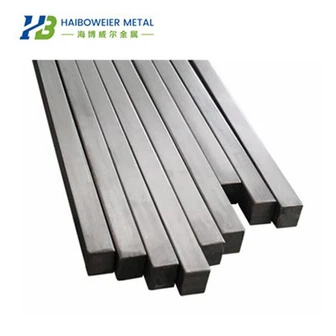
Is titanium hard? How hard is titanium?
Hardness is one of the most commonly used indicators for evaluating the mechanical properties of metal materials. The essence of hardness is the ability of a material to resist the pressure of another harder material. It is widely used in metal performance inspection, heat treatment process quality supervision and the development of new materials. The application field of titanium metal is very wide, from aerospace to medical equipment, from sporting goods to jewelry, almost everywhere. So, is titanium hard? How hard is titanium?
In fact, hardness is not the only criterion for measuring the strength of a material. Hardness usually refers to the ability of a material to resist local pressure deformation, scoring or scratching. Although the hardness of titanium metal is not as good as some other metals such as steel or diamond, its unique strength and toughness give it unique advantages. In common titanium and titanium alloy bar standards, such as GB/T 2965-2007, GJB2218A-2008, and GJB1538A-2008, hardness is not used as an acceptance criterion. However, in engine and forging standards with higher requirements, such as GJB2744A-2007 and GJB494A-2008, hardness is required as an acceptance basis, usually testing Rockwell hardness or Brinell hardness.
Laboratory hardness sampling size:
1.HRC (Rockwell hardness)
Bar sampling size
d>25 Φ25x20 or 25x25x20
d≤25 diameter x20 (cylindrical)
Plate sampling size
δ>20 Φ25x20 or 25x25x20
δ≤20 Φ25x plate thickness or 25x25x plate thickness
2.HB (Brinell hardness)
Bar sampling size
d>40 Φ40x20 or 40x40x20
d≤40 diameter x20 (cylindrical)
Plate sampling size
δ>40 Φ40x20 or 40x40x20
δ≤40 Φ40x plate thickness or 40x40x plate thickness
3.HV (Vickers hardness)
Bar sampling size
d>20 Φ20x20 or 20x20x20
d≤20 diameter x20 (cylindrical)
plate sampling size
δ>20 Φ20x20 or 20x20x20
δ≤20 Φ20xplate thickness or 20x20xplate thickness
Commonly used titanium and titanium alloy hardness table
|
Serial number |
Brand number |
Hardness |
| 1 | TA0 | 120HB |
| 2 | TA2 | 200~296HB |
| 3 | TA7 | 277~286HB |
| 4 | TA10 | 180~215HB |
| 5 | TA11 | 275~313HB |
| 6 | TA12 | 305~316HB |
| 7 | TA13 | 305~316HB |
| 8 | TA15 | 225~314HB |
| 9 | TA18 |
15 ~ 17 HRC |
| 10 | TA19 | 309HBS |
| 11 | Ti-55 | 33 ~ 34HRC |
| 12 | TC1 | 210~215HB |
| 13 | TC4(Annealing state) | 255~341HB |
| TC4(Solution aging state) | 293~361HB | |
| 14 | TC6 | 285~340HB |
| 15 | TC11 | 331~343HB |
| 16 | TC16(Annealed) | 230~280HB |
|
TC16 (Time-limited state) |
340~370 HB |
|
| 17 | TC17 | 337~357HB |
| 18 | TC18 | 310~360HB |
| 19 | TC19 | 337~357HB |
| 20 | TC21 | 36~43HRC |
| 21 | TB3(Solid solution) | 269HB |
| TB3(Aging) | 395HB | |
| 22 | TB6 | 335~375HB |
| 23 | TB8 | 352~373HB |
According to German standard DIN50150.
The following is a comparison table of commonly used steel tensile strength and Vickers hardness, Brinell hardness, and Rockwell hardness:
| tensile strength Rm(N/mm2) |
Vickers hardness HV |
Brinell hardness HB |
Rockwell hardness HRC |
| 250 | 80 | 76.0 | - |
| 270 | 85 | 80.7 | - |
| 285 | 90 | 85.2 | - |
| 305 | 95 | 90.2 | - |
| 320 | 100 | 95.0 | - |
| 335 | 105 | 99.8 | - |
| 350 | 110 | 105 | - |
| 370 | 115 | 109 | - |
| 380 | 120 | 114 | - |
| 400 | 125 | 119 | - |
| 415 | 130 | 124 | - |
| 430 | 135 | 128 | - |
| 450 | 140 | 133 | - |
| 465 | 145 | 138 | - |
| 480 | 150 | 143 | - |
| 490 | 155 | 147 | - |
| 510 | 160 | 152 | - |
| 530 | 165 | 156 | - |
| 545 | 170 | 162 | - |
| 560 | 175 | 166 | - |
| 575 | 180 | 171 | - |
| 595 | 185 | 176 | - |
| 610 | 190 | 181 | - |
| 625 | 195 | 185 | - |
| 640 | 200 | 190 | - |
| 660 | 205 | 195 | - |
| 675 | 210 | 199 | - |
| 690 | 215 | 204 | - |
| 705 | 220 | 209 | - |
| 720 | 225 | 214 | - |
| 740 | 230 | 219 | - |
| 755 | 235 | 223 | - |
| 770 | 240 | 228 | 20.3 |
| 785 | 245 | 233 | 21.3 |
| 800 | 250 | 238 | 22.2 |
| 820 | 255 | 242 | 23.1 |
| 835 | 260 | 247 | 24.0 |
| 850 | 265 | 252 | 24.8 |
| 865 | 270 | 257 | 25.6 |
| 880 | 275 | 261 | 26.4 |
| 900 | 280 | 266 | 27.1 |
| 915 | 285 | 271 | 27.8 |
| 930 | 290 | 276 | 28.5 |
| 950 | 295 | 280 | 29.2 |
| 965 | 300 | 285 | 29.8 |
| 995 | 310 | 295 | 31.0 |
| 1030 | 320 | 304 | 32.2 |
| 1060 | 330 | 314 | 33.3 |
| 1095 | 340 | 323 | 34.4 |
| 1125 | 350 | 333 | 35.5 |
| 1115 | 360 | 342 | 36.6 |
| 1190 | 370 | 352 | 37.7 |
| 1220 | 380 | 361 | 38.8 |
| 1255 | 390 | 371 | 39.8 |
| 1290 | 400 | 380 | 40.8 |
| 1320 | 410 | 390 | 41.8 |
| 1350 | 420 | 399 | 42.7 |
| 1385 | 430 | 409 | 43.6 |
| 1420 | 440 | 418 | 44.5 |
| 1455 | 450 | 428 | 45.3 |
| 1485 | 460 | 437 | 46.1 |
| 1520 | 470 | 447 | 46.9 |
| 1555 | 480 | (456) | 47.7 |
| 1595 | 490 | (466) | 48.4 |
| 1630 | 500 | (475) | 49.1 |
| 1665 | 510 | (485) | 49.8 |
| 1700 | 520 | (494) | 50.5 |
| 1740 | 530 | (504) | 51.1 |
| 1775 | 540 | (513) | 51.7 |
| 1810 | 550 | (523) | 52.3 |
| 1845 | 560 | (532) | 53.0 |
| 1880 | 570 | (542) | 53.6 |
| 1920 | 580 | (551) | 54.1 |
| 1955 | 590 | (561) | 54.7 |
| 1995 | 600 | (570) | 55.2 |
| 2030 | 610 | (580) | 55.7 |
| 2070 | 620 | (589) | 56.3 |
| 2105 | 630 | (599) | 56.8 |
| 2145 | 640 | (608) | 57.3 |
| 2180 | 650 | (618) | 57.8 |
| 660 | 58.3 | ||
| 670 | 58.8 | ||
| 680 | 59.2 | ||
| 690 | 59.7 | ||
| 700 | 60.1 | ||
| 720 | 61.0 | ||
| 740 | 61.8 | ||
| 760 | 62.5 | ||
| 780 | 63.3 | ||
| 800 | 64.0 | ||
| 820 | 64.7 | ||
| 840 | 65.3 | ||
| 860 | 65.9 | ||
| 880 | 66.4 | ||
| 900 | 67.0 | ||
| 920 | 67.5 | ||
| 940 | 68.0 |
The hardness of titanium metal is mainly reflected in its high strength and excellent toughness. This metal can withstand extremely high pressure and tension while maintaining good elasticity. This makes titanium metal have irreplaceable advantages in the manufacture of high-performance aircraft, spacecraft and automotive parts.