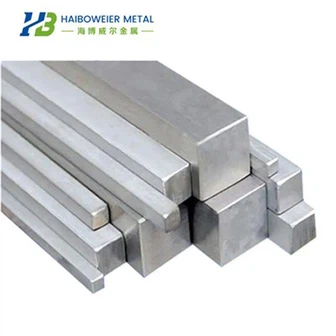
Characteristics and applications of commonly used brands of titanium rods
Titanium's ability to alloy makes the metal stronger and more durable, and we provide you with a reliable metal that can withstand a variety of impacts. The strength of titanium rods depends on the material the titanium is made of; here's how they differ:
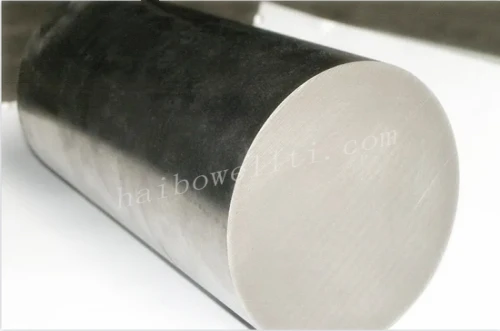
Pure titanium rod
GR1, GR2, GR3 are considered pure titanium. We supply pure titanium rods to meet the needs and expectations of a range of industries
GR1 pure titanium rod
Compared to other metal rods, GR1 titanium rods are the softest, most malleable metal we offer. Having said that, GR1 offers high levels of formability and corrosion resistance, as well as impact toughness.
Our titanium rods are used in a wide range of applications including chemical processing, construction and automotive parts, while GR1 titanium rods are also used by the medical industry for surgical implants and devices.
GR2 pure titanium rod
GR2 titanium rod is known as a commercial pure "workhorse" that provides useful strength for a wide range of applications. Comparing GR2 titanium to GR1 titanium, GR2 titanium is slightly stronger and offers excellent weldability, strength, and ductility, ultimately making it a regular choice in industry.
GR2 titanium rods can be used in similar applications to GR1 titanium rods, but can also be used in power generation, hydrocarbon processing and desalination.
Titanium alloy rod
Titanium is alloyed with another metal for greater strength. Combining the properties of titanium with other metals will provide a reliable metal with good quality.
GR5 titanium alloy rod
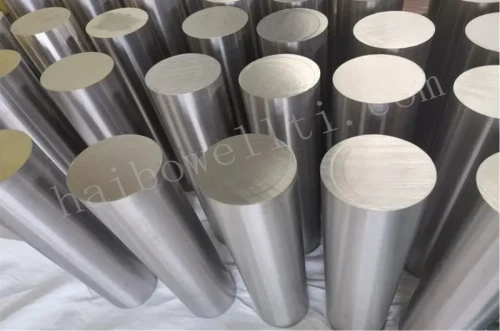
As the "workhorse" titanium alloy, GR5 has countless advantages, which is why it is so popular. While GR5 titanium is known for its high strength and low weight, the strength can be increased through heat treatment. Like any other titanium rod or plate, GR5 titanium alloy is equally corrosion resistant.
GR5 titanium is used in the following industries; aerospace, marine and medical and can also be used in chemical processing. Apart from this, these titanium rods are also used in the manufacture of aircraft turbines, engine parts and automatic components.
GR7 titanium alloy rod
Some of the features of the GR7 we offer are similar to those of the GR2. The physical and mechanical strength of GR7 titanium rods can be closely matched with GR2 titanium rods, except that they have higher corrosion resistance and have high weldability. You will find that GR7 titanium comes in handy when manufacturing production equipment and components in corrosive environments. In addition to this, it is designed for chemical processing applications with high strength and reliability.
GR12 titanium alloy rod
GR12 (Ti-0.3Mo-0.8Ni) titanium alloy is a corrosion-resistant titanium alloy. It is a near-α alloy developed to improve the crevice corrosion performance of pure titanium. The alloy contains 0.3% Mo and 0.8% Ni, which not only strengthens alloy, and has good crevice corrosion resistance to high temperature, low pH chloride or weak reducing acid. Its corrosion resistance is better than pure titanium and close to GR7 alloy. GR12 alloy also has good process plasticity and welding performance, and has been fully used in the chemical industry. The alloy can be used in the annealed state, and its main products include plates, rods, pipes, forgings and wires. Similar foreign brands are Gr.12.
BT9 titanium alloy rod
The nominal composition of BT9 titanium alloy is Ti-6.5Al-3.5Mo-1.5Zr-0.3Si. It is an α-β type titanium alloy heat-resistant titanium alloy with an aluminum equivalent of 3.5 and a molybdenum equivalent of 7.3.
BT9 titanium alloy is a high-temperature titanium alloy widely used in aviation, with an operating temperature of 500°C. It is mainly used in parts of aero-engine compressors, such as blades, discs, drums and shafts. It can also be made into special-shaped castings. The working conditions of the parts are: in the annealed state, it can be used for 500 hours below 500°C, 100 hours below 550°C, and 1,000 hours below 450°C. In the strengthened state, it can be used for 100 hours below 500°C. parts and one-time working parts below 700℃.