How many protons and neutrons does titanium have?
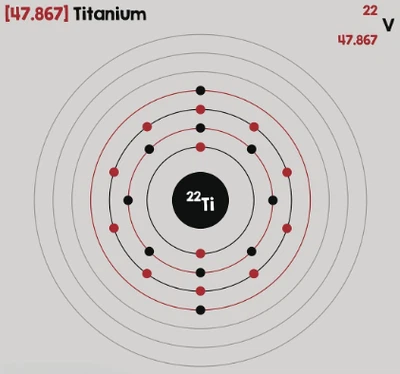
Titanium is a common metal element with the chemical symbol Ti and atomic number 22. In physics, the nucleus is composed of protons and neutrons, while electrons surround the nucleus to form an electron shell. The atomic structure of titanium is the same, including protons, neutrons and electrons.So, how many protons and neutrons does a titanium atom have?
1. Basic information about titanium
First, let's take a look at the basic information about titanium. Titanium is a silvery-white transition metal with an atomic number of 22, located in the fourth period and IVB group of the periodic table. As a lightweight, high-strength metal, the density of titanium is only 57% of that of steel, but its strength is comparable to that of steel. This excellent physical property makes titanium the only choice for manufacturing high-performance materials.
2. The number of protons and neutrons in titanium
So, how many protons and neutrons does titanium have? According to the information of the periodic table of chemical elements, we can easily know that the atomic nucleus of titanium contains 22 protons, which determines its chemical properties and elemental characteristics, while the number of neutrons of titanium varies depending on the isotope. The main isotopes of titanium are titanium-46, titanium-47, titanium-48, titanium-49 and titanium-50, among which the most common is titanium-48, which contains 22 protons and 26 neutrons.
3. Isotopes of titanium
Isotopes refer to different atoms of the same element with the same number of protons but different numbers of neutrons. There are 5 natural isotopes of titanium, namely Ti-46, Ti-47, Ti-48, Ti-49 and Ti-50, with 24, 25, 26, 27 and 28 neutrons respectively. In addition, titanium has a variety of artificially synthesized isotopes, among which Ti-44 is the most stable. Other isotopes such as Ti-45, Ti-51, Ti-52, etc. are also used in research and applications, with neutron numbers of 22, 23, 29 and 30 respectively.
Titanium isotopes are widely used in production, scientific research and other fields. For example, in nuclear medicine and radioisotope preparation, Ti-44 is used to produce low-radioactive Sc-44m, which can be used for single-photon emission computed tomography. Ti-48 can be used to evaluate the neutron absorption cross-section of graphite blocks, and can also be used to produce semiconductor materials and graphite compounds.
4. Physical and chemical properties of titanium
Next, let's take a look at how the protons and neutrons of titanium affect its physical and chemical properties. Protons determine the chemical properties of elements because they are positively charged particles in the nucleus, and their interaction with electrons determines the behavior of elements in chemical reactions. Neutrons mainly affect the physical properties of elements, such as mass, density and stability. Due to the moderate number of protons and neutrons in titanium, titanium has excellent comprehensive properties, such as high strength, low density, and corrosion resistance.

5. Uses of titanium
As an important metal material, titanium has a wide range of applications in industry and science. It has excellent properties such as good corrosion resistance, high strength and low density, and is often used in aerospace, shipbuilding, biomedicine and other fields. Due to the stable atomic structure of titanium, it has a high melting point and antioxidant properties, which is suitable for engineering applications in high temperature environments. Titanium is also biocompatible and can be used for human implant materials, such as artificial bones and dental implants, and is favored by the medical community.
In general, as an important metal element, titanium contains 22 protons and 20-30 neutrons in its atomic structure. Protons and neutrons together constitute a stable atomic nucleus, giving titanium unique chemical properties and physical properties. The wide range of applications and excellent properties of titanium make it one of the indispensable and important materials in today's industry and science.