


How to Choose the Right Titanium Plate?
When the subject of industrial metal materials arises, titanium plates are often the first thing that comes to mind. However, many people lack a clear understanding of their specific applications, processing methods, and the critical details to consider when selecting specifications. Join Haiboweier Metal as we discuss these topics and explore how titanium plates are utilized in actual industrial settings.
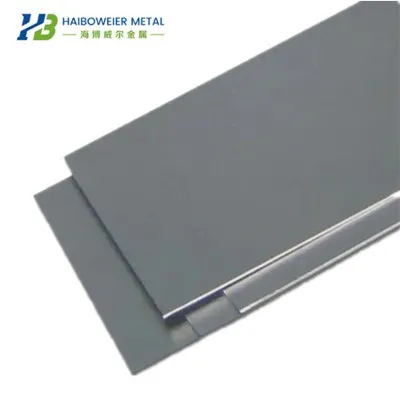
Titanium Plate Specifications
Unlike ordinary steel plates, titanium plates require careful selection regarding specifications; choosing an unsuitable size can directly impact subsequent processing and end-use performance. Common thicknesses range from 0.5 mm to several tens of millimeters, while width and length can be customized to meet specific production requirements.
In terms of material grade, Grade 1 and Grade 2 titanium are the most common forms of commercially pure titanium (CP titanium). These grades are favored for their excellent ductility, making them easy to process, form, and coil. Grade 5 titanium, conversely, is typically reserved for aerospace applications, components requiring high structural strength, and high-end industrial equipment.
Titanium Plate Processing Methods
Processing titanium plates is more challenging and demands stricter standards than processing stainless steel. This is primarily due to its unique physical properties: excessive heat can cause the material to absorb oxygen and hydrogen, while temperatures that are too low result in significant springback. Consequently, precise temperature control is absolutely critical. Common processing methods include:
Rolling: From Ingot to Plate
This process involves two methods: hot rolling and cold rolling. Hot rolling begins by forging or rolling the titanium ingot into a slab, which is simultaneously heated to a temperature between 850°C and 870°C before undergoing the hot-rolling process. Thin plates are produced by subjecting the hot-rolled material to a subsequent cold-rolling process; prior to this, the material must undergo annealing, pickling, and oxide layer removal. Following cold rolling, a vacuum annealing step is required to prevent surface discoloration.
Forming:Bending and Stamping
During bending and stamping operations, particular attention must be paid to "springback." Titanium exhibits greater elasticity than other metals; when a bend is released, the material will spring back slightly toward its original shape. Therefore, it is essential to incorporate a margin of allowance when calculating bending angles and dimensions.
Welding: The Most Challenging Process
Gas Tungsten Arc Welding (GTAW), commonly known as TIG welding, is the standard method used for titanium. This process requires a protective atmosphere of high-purity argon gas (with a purity level of no less than 99.99%). Without adequate shielding, welding can result in defects such as porosity, cracking, and oxidation. Consequently, the weld joint must be thoroughly cleaned and prepared prior to welding. The quality of the weld ultimately determines the service life of the component.
Cutting and Surface Treatment:
Thin titanium plates can be cut directly using mechanical shears. For thicker plates-particularly when manufacturing precision components-laser cutting or plasma cutting technologies are required. Surface oxidation, sandblasting, or coating can enhance corrosion resistance and improve the aesthetic appearance.
Please take the above recommendations into account when selecting the titanium plate suitable for your project, in order to avoid incurring unnecessary costs.


