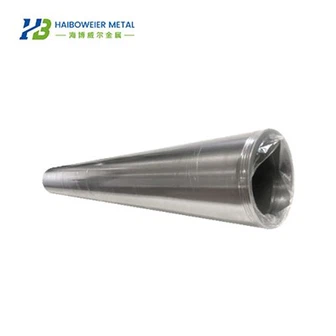
Introduction to the characteristics of titanium metal, what are the uses of titanium?
In the world of metals, there is an element that has attracted much attention for its unique properties and wide range of applications, and that is titanium. Titanium, a transition metal in the fourth period and fourth group of the periodic table, has won the reputation of "space metal" for its silvery-white luster and hard texture, and plays an indispensable role in many fields such as science and technology, medicine, and chemical industry. So what are the characteristics of titanium metal? Today, let us walk into the world of titanium metal and explore its mystery and charm.

1. Titanium is high in strength and light in weight
Titanium has a relatively low density of about 4.5g/cm³, which is 43% lighter than steel and slightly heavier than the prestigious light metal magnesium. Despite this, its mechanical strength is similar to that of steel, twice that of aluminum, and five times that of magnesium.
2. Titanium corrosion resistance
Titanium can react with non-metals such as O2, N2, H2, S and halogens at room temperature, but at room temperature, a very thin and dense oxide protective film is easily formed on the titanium surface, which can resist the action of strong acid and even aqua regia, showing strong corrosion resistance.
Good corrosion resistance, not affected by the atmosphere and seawater, will not be corroded by dilute hydrochloric acid, dilute sulfuric acid, nitric acid or dilute alkali solution at room temperature; only hydrofluoric acid, hot concentrated hydrochloric acid, concentrated sulfuric acid, etc. can act on it.
3. Titanium heat resistance
Titanium has a melting point of up to 1668℃ and a boiling point of 3287℃, and has good heat resistance. Usually, aluminum loses its original properties at 150℃ and stainless steel loses its original properties at 310℃, while titanium alloys still maintain good mechanical properties at around 500℃.
4. Low temperature performance
The strength of some titanium alloys (such as Ti-5AI-2.5SnELI) increases with decreasing temperature, but the plasticity does not decrease much, and it still has good ductility and toughness at low temperatures. (The plasticity of titanium mainly depends on purity. The purer the titanium, the greater the plasticity)

5. Biocompatibility
Titanium has good compatibility with human tissues and organs and is widely used in medical devices such as artificial hip joints, knee joints, shoulder joints, etc. This feature makes titanium an ideal choice for medical implants, such as joint replacements and dental implants. Titanium has the ability to fuse with bones, which can promote faster healing and reduce the risk of rejection.
6. Titanium is non-magnetic
Titanium is non-magnetic and will not be detected by mines, which has a good anti-surveillance effect.
7. Shape memory properties
Titanium and nickel alloys (Nitinol) have shape memory properties. Springs made of this alloy will return to their original shape once heated after being deformed.
These characteristics make titanium in the fields of aviation and aerospace. Its strength-to-weight ratio enables the structures of aircraft and spacecraft to withstand extreme conditions while remaining lightweight. Whether in aircraft fuselages or satellite shells, the presence of titanium ensures excellent performance and safety.
Titanium has more uses, such as in chemical and petrochemical, transportation, weapons, ocean, electricity, construction, metallurgy, medical treatment, sports equipment, daily necessities and light industry and other fields!