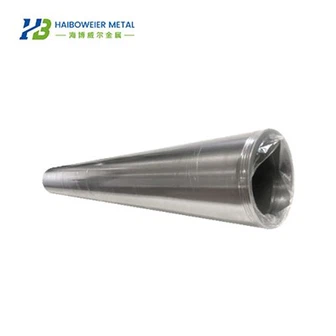
A Must-Read For The Chlor-Alkali Industry: Advantages Of Titanium Alloy Electrolytic Cells
In chlor-alkali production, the electrolytic cell is one of the core pieces of equipment, directly determining the efficiency and stability of products such as chlorine and caustic soda. The process involves high-concentration brine, electrochemical reactions, and highly corrosive environments, placing extremely demanding requirements on materials. Traditional materials often suffer from corrosion, scaling, and performance degradation during long-term operation, affecting both productivity and safety. With advances in material technology, titanium alloys-known for their excellent corrosion resistance and stability-have become a preferred choice for electrolytic cells, offering significant advantages in improving efficiency and reducing maintenance costs.

Outstanding Corrosion Resistance Ensures Long-Term Stability
The chlor-alkali process involves large amounts of chloride ions and corrosive media, making corrosion resistance essential.
- Titanium alloys exhibit excellent resistance to high-concentration chloride environments, greatly extending equipment lifespan
- A dense oxide layer forms naturally on the surface, continuously protecting the material from further corrosion
- Maintain stability during electrolysis without significant chemical degradation
- Reduce equipment failure and downtime caused by corrosion compared to conventional metals
This superior corrosion resistance makes titanium alloys an ideal material for electrolytic cells in the chlor-alkali industry.
Reliable Electrical and Thermal Performance Improves Efficiency
The performance of electrolytic cells depends heavily on the material's conductive and thermal properties.
- Titanium alloys provide stable electrical conductivity, supporting efficient electrolysis
- Good thermal conductivity helps maintain uniform temperature distribution
- Reduce localized overheating, enhancing operational safety
- Improve overall electrolysis efficiency and reduce energy consumption
These properties play a key role in enhancing production efficiency.
Anti-Scaling Properties Reduce Maintenance Costs
Deposits and scaling are common challenges in electrolysis systems.
- The smooth surface of titanium alloys minimizes the adhesion of impurities and deposits
- Slows down scaling formation, reducing cleaning frequency
- Maintains active surfaces for consistent electrochemical reactions
- Lowers additional energy consumption caused by scale buildup
Improved anti-scaling performance helps ensure stable operation and lower maintenance costs.
Strong Structural Stability for Demanding Operating Conditions
Electrolytic cells must withstand mechanical and thermal stresses during continuous operation.
- Titanium alloys offer high strength to handle long-term structural loads
- Excellent fatigue resistance supports continuous production environments
- Maintain dimensional stability under temperature fluctuations
- Enable the design of large-scale electrolytic systems with improved safety
- Extend service life and reduce replacement frequency
These reliable properties make titanium alloys highly suitable for industrial applications.
As the chlor-alkali industry moves toward higher efficiency, energy savings, and sustainable production, upgrading electrolytic cell materials has become essential. Titanium alloys, with their outstanding corrosion resistance, reliable electrical and thermal performance, strong anti-scaling properties, and excellent mechanical stability, demonstrate significant value in electrolytic cell applications. Their use not only improves operational efficiency but also reduces maintenance costs and failure risks. With ongoing technological advancements, titanium alloys will play an increasingly important role in supporting the high-quality development of the chlor-alkali industry.