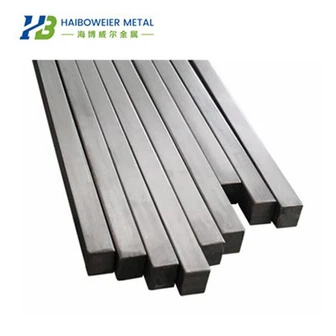
For Aerospace Components, Should Titanium Rods Or Titanium Alloy Rods Be Selected?
In modern aerospace technology, the material selection of components directly affects the performance, safety, and lifespan of spacecraft. Titanium rods and titanium alloy rods are widely used as high-performance materials in aerospace, but they differ in mechanical properties, high-temperature resistance, and processing adaptability. Choosing the right material ensures component reliability in extreme environments, achieves lightweight design, and optimizes performance, providing long-term stable material support for aerospace equipment.

Comparison of Mechanical Properties
Aerospace components must withstand complex loads, making material strength and rigidity critical:
- High specific strength of titanium rods: Pure titanium rods have moderate strength and low density, suitable for low- to medium-strength load-bearing parts.
- Strength advantage of titanium alloy rods: Alloying significantly increases strength compared to pure titanium, making them ideal for high-stress components.
- Fatigue resistance: Titanium alloy rods perform better under cyclic loading conditions.
- Structural safety margin: Titanium alloy rods provide higher safety factors to meet critical load-bearing requirements.
High-Temperature and Environmental Adaptability
Spacecraft may encounter extreme temperatures in high altitudes or engine compartments, making heat resistance essential:
- Temperature stability of titanium rods: Suitable for components exposed to moderate temperature variations.
- High-temperature capability of titanium alloy rods: Maintains strength and dimensional stability under elevated temperatures.
- Oxidation resistance: Titanium alloy rods experience less performance degradation in high-temperature oxidative environments.
- Adaptable to extreme conditions: Ideal for engines, fuel lines, and other complex aerospace applications.
Machinability and Manufacturing Cost
The ease of machining and cost are also key factors in material selection:
- Titanium rods are easier to process: Suitable for simple shapes or lower-precision components, reducing machining difficulty.
- Titanium alloy rods are more challenging to machine: Require precision equipment and processes, but are suitable for complex structures.
- Welding and connection compatibility: Titanium rods fit traditional joining methods, while titanium alloy rods support precision welding and integrated designs.
- Overall cost considerations: Titanium alloy rods have higher material and machining costs but reduce maintenance and replacement frequency.
Application Scenarios and Material Selection Recommendations
Different aerospace components have varying requirements, and material choice should match actual conditions:
- Load-bearing structural parts: Critical high-stress components are recommended to use titanium alloy rods.
- Non-load-bearing parts: Lightweight brackets or conduits can use pure titanium rods.
- High-temperature components: Engine interfaces and nozzles should use titanium alloy rods for heat resistance.
- Balanced performance: Optimize between weight, cost, and performance to ensure overall spacecraft efficiency.
Both titanium rods and titanium alloy rods have their advantages, and the key is to select based on component function and operating conditions. Titanium rods are suitable for medium- to low-strength, lightweight components, while titanium alloy rods perform better in high-strength, high-temperature, and critical load-bearing parts. Scientific material selection allows aerospace components to remain stable and reliable under extreme environments while achieving lightweight and optimized structures, providing efficient and long-term stable material solutions for spacecraft.