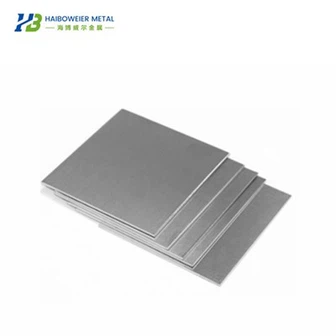
A comprehensive overview of the nickel alloy process from raw materials to finished products
Nickel alloys, as an indispensable key material in modern industry, are widely used in high-end fields such as aerospace, energy and chemical engineering, and marine engineering due to their excellent corrosion resistance, high-temperature strength, and oxidation resistance. From raw ore to finished product, nickel alloy production involves five core steps: raw material handling, smelting, processing, heat treatment, and quality testing. The process selection and parameter control at each step directly impact the product's performance stability and reliability.

Raw Material Processing
Nickel alloy raw materials are primarily divided into two categories: nickel ore and metal raw materials. Targeted processing techniques are selected based on the ore type:
Laterite Nickel Ore
Approximately 60% of the world's nickel resources exist in the form of laterite nickel ore. Its processing techniques are divided into two types: pyrometallurgical and hydrometallurgical.
Pyrometallurgical: Suitable for high-nickel-grade ores (Ni>1.5%). The typical process is "rotary kiln drying and pre-reduction followed by electric furnace reduction and smelting." The ore is dehydrated and partially reduced in a rotary kiln at 800-900°C to produce a nickel-iron alloy. It is then deeply reduced in an electric furnace at 1500-1600°C to produce nickel-iron with a nickel content of 15%-20%, achieving a nickel recovery rate of 90%-92%.
Wet process: For low-grade ores (Ni < 1.5%), high-pressure acid leaching (HPAL) is the mainstream method. After crushing and grinding, the ore is leached with dilute sulfuric acid at 240-260°C and 4-5 MPa, achieving a nickel leaching rate exceeding 90%. The leachate is purified through neutralization, precipitation, solvent extraction, and other steps, ultimately producing high-purity nickel plates through electrolysis. This process reduces energy consumption by 25%-30% compared to the pyrometallurgical process.
Nickel Sulfide Ore
Nickel sulfide ore must first be enriched through flotation (nickel content >3% can be directly charged to the furnace) and then undergoes pyrometallurgical smelting:
Flash smelting: Ore fines are mixed with oxygen-enriched air at high speed in a flash furnace, reacting rapidly at 1300-1350°C to produce low-grade nickel matte (nickel content 40%-60%). The sulfur oxidation rate reaches over 98%, and the flue gas is recycled through an acid production system.
Converter Blowing: The low-grade nickel matte is transferred to the converter and oxidized with compressed air to remove iron, producing high-grade nickel matte (nickel content 70%-78%), which provides raw material for subsequent electrolytic refining.
Metal Raw Materials
Metal raw materials such as nickel plate, ferrochrome, and cobalt must undergo composition verification and particle size control. For example, nickel-based alloys for aircraft engine blades require a nickel content fluctuation of ≤±0.05%. The raw materials must be jet-milled to a mesh size of 200-325 to ensure uniform composition during smelting.
Smelting Process
Modern nickel alloy smelting generally utilizes a "duplex" or "triplex" process, utilizing multi-stage melting to collaboratively control composition and impurities:
Vacuum Induction Melting (VIM)
Under a vacuum environment of 10⁻²-10⁻³ Pa, the raw materials are melted using electromagnetic induction heating, effectively inhibiting oxidation and removing gases (such as H and O). The melting temperature is controlled between 1500°C and 1580°C, and the melt pool stirring intensity is adjusted using electromagnetic field parameters to ensure compositional uniformity that meets ASTM E1507 standards.
Electroslag Remelting (ESR)
Using the ingot to be refined as the anode and a water-cooled crystallizer as the cathode, impurities such as sulfur and oxygen are removed through slag-metal interfacial reactions. The slag system uses a ternary system of CaF₂-Al₂O₃-CaO. The melting rate is controlled at 3-5 kg/min, and the sulfur content can be reduced from 0.005% to below 0.001%.
Vacuum Consumable Remelting (VAR)
A water-cooled copper mold controls the solidification rate and suppresses element segregation. The melt rate is maintained at a constant 2-4 kg/min, and the vacuum is maintained below 10⁻² Pa. The axial composition fluctuation of the ingot is ≤±0.03%, and the shrinkage defect rate is reduced to below 0.5%.
Processing Technology
Nickel alloy processing requires a combination of hot and cold working to achieve dual control of shape and performance:
Forging
Microstructure improvement is achieved through high-pressure deformation. Nuclear power main pipeline forgings utilize isothermal forging at 1000-1050°C, maintaining a deformation of 60%-70%. This refines the grain size from ASTM grade 5 to grade 8, and improves fatigue resistance by 2-3 times.
Rolling
Hot rolling: Multiple deformation passes are performed above the recrystallization temperature. Nickel-based alloy sheet is produced through a controlled rolling and cooling process, with a final rolling temperature of 950-1000°C and a cooling rate of 10-15°C/s, achieving an optimal balance between strength (σb = 950-1050 MPa) and toughness (AKV = 70-90 J).
Cold rolling: Surface precision is improved through high reduction deformation. The precision strip production line utilizes an online thickness gauge to maintain a thickness tolerance within ±1μm and a surface roughness Ra ≤ 0.2μm, meeting electronic packaging requirements.
Drawing
Multi-pass cold drawing combined with intermediate annealing produces high-precision welding wire. The use of nanographite lubricant reduces drawing force by 20%-25%, lowering surface roughness from Ra 0.8μm to below Ra 0.2μm, and reducing weld crack rate to below 0.1%.
Heat Treatment
Heat treatment alters the alloy's microstructure through a heating-cooling cycle and is a key step in optimizing performance:
Solution Treatment
Heat the alloy to 1100-1150°C and hold for 1-2 hours to fully dissolve the precipitated phase. For example, after solution treatment, N6 nickel alloy exhibits a 30% improvement in grain size uniformity and a 15%-20% increase in ductility and toughness.
Aging Treatment
Hold the alloy at 700-850°C for 12-24 hours to promote the precipitation of γ' phase. A two-stage aging treatment (760°C for 8 hours + 620°C for 16 hours) for aircraft engine blade alloys achieves high-temperature endurance strength of 600-700 MPa, a 30%-40% increase compared to single-stage aging.
Cryogenic Treatment
Liquid nitrogen treatment at -196°C eliminates retained austenite. Cryogenic treatment of offshore platform components improves dimensional stability by 40%-50%, wear resistance by 25%-30%, and service life by over 20 years.
Quality Inspection
From raw materials to finished products, quality is ensured through multiple levels of testing:
Chemical Analysis: Spark direct-emission spectrometers are used to rapidly analyze composition, with fluctuations controlled within ±0.01%.
Metallographic Examination: Electron Backscatter Diffraction (EBSD) is used to analyze grain orientation and ensure that high-temperature creep rates meet standards.
Non-destructive Testing: Industrial CT detects internal defects with a sensitivity of up to 0.02 mm (Ø), and a defect miss rate of less than 0.1%.
After passing inspection, the final product is vacuum-packed and moisture-proofed to ensure stable performance during transportation.
Nickel alloy production lies at the intersection of materials science, metallurgical engineering, and precision manufacturing. Its core lies in achieving a precise match between composition, structure, and properties through multi-level process control. As material performance requirements continue to rise in aerospace, new energy, and other fields, nickel alloy processing is evolving towards higher purity, finer grain size, and improved thermal stability.