


Annealing heat treatment of titanium and titanium alloys
A process of annealing: natural aging method.
The natural aging method was a method commonly used in the early days of stress relief equipment. The principle is to place metal workpieces in the open air for three to five months, and then slowly release the stress after being exposed to wind and rain by nature. After one year of natural aging of the workpiece using this stress removal method, the residual stress is only reduced by 2 to 10%, but it greatly improves the relaxation stiffness of the workpiece, so the dimensional stability of the workpiece is very good. However, because it takes too long, it is generally not used in actual production.
Today I will mainly talk about the annealing of titanium and titanium alloys. In our daily titanium production process, customers often give product requirements: M state, R state, Y state.
According to the standard, the correspondence is as follows:
M state: represents the annealing state.
R state: indicates the thermal processing state.
Y state: indicates the cold working state.
1. Stress relief annealing: The purpose is to eliminate the internal stress after processing or welding of industrial pure titanium and titanium alloy parts. The annealing temperature is generally 450~650℃, the holding time is 1~4h (depending on the size of the product), and air cooling.
Recrystallization annealing: The purpose is to eliminate work hardening. For pure titanium, the temperature is generally 550~690℃, while for titanium alloy, the temperature is 750~800℃, the holding time is 1~3h (depending on the size of the product), and air cooling.
According to our experience, it can generally heat 2mm per minute. Then take a product with a diameter of 500MM as an example:
T (heat treatment time)=(radius/2)+30~40
It's about 2.5 hours.
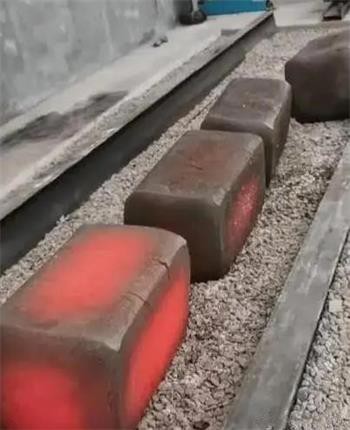
Titanium alloy (Gr5) one fire, three piers and three pulls, air cooling
2. Quenching and aging heat treatment of titanium alloy
The purpose of quenching and aging is to improve the strength and hardness of titanium alloys.
α titanium alloys and (α + β) titanium alloys containing less β stabilizing elements, when quenched from the β phase zone, a diffusion-free martensitic transformation r→α′ occurs. α′ is a supersaturated solid solution of B stabilizing element in α-Ti. α′ martensite has the same crystal structure as α, with a close-packed hexagonal lattice. α′ has low hardness and good plasticity. It is an unbalanced structure. It decomposes into a mixture of α phase and β phase during heating and aging, and the strength and hardness increase.
β titanium alloys and (α + β) titanium alloys containing more stabilizing elements, after quenching, the β phase changes into a metastable β phase. During heating and aging, the metastable β phase precipitates into a dispersed α phase, which improves the strength and strength of the alloy. Increased hardness.
Alpha titanium alloys generally do not undergo quenching and aging treatments.
3. Titanium alloy and (α+β) titanium alloy can be quenched and aged to improve strength and hardness.
The quenching temperature of titanium alloys is generally selected in the upper range of the α+β two-phase region. After quenching, part of α is retained, and the fine β phase becomes a dielectric stable β phase or α′ phase or both (determined by β stabilization content of elements), good comprehensive mechanical properties can be obtained after aging. If heated to the β single-phase region, β grains will easily grow, and the toughness after heat treatment will be very low. Generally, the quenching temperature is 760~950℃, the holding time is 5~60min, and it is cooled in water.
The aging temperature of titanium alloys is generally between 450 and 550°C, and the aging time is from a few hours to dozens of hours.
When titanium alloy heat treatment is heated, contamination and oxidation should be prevented, and overheating should be strictly prevented. After the β grains grow up, they cannot be saved by heat treatment.

Gr5(TC4) 100X metallographic structure


