


Cold-Rolled Titanium Sheet vs. Hot-Rolled Titanium Sheet: What are the Differences?
In practical applications of titanium sheets, one of the most frequently asked questions by customers is actually quite simple:
What exactly is the difference between cold-rolled and hot-rolled titanium sheets? Is it just a price difference?
From a production perspective, the differences between these two processes are far more complex than simply being "a little more expensive or a little cheaper." They directly affect the surface condition, processing performance, and even the final application of the material.
Let's break it down in a more intuitive way.
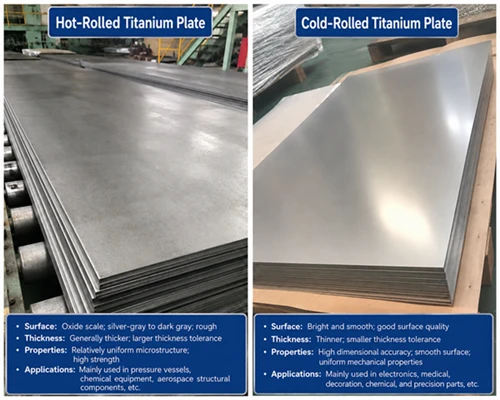
I. Cold-Rolled Titanium Sheet: A More Refined Processing Route
Cold-rolled titanium sheets are typically not formed in one step. They are formed by pressing hot-rolled coils through a second "cold working" process.
Simply put, it's first hot-formed, then cold-rolled to refine the dimensions and surface.
During this process, the material undergoes pickling, continuous rolling, and other processes. Because deformation occurs at room temperature, the internal structure of the titanium material is further compressed, leading to a typical phenomenon-work hardening.
The result is:
Strength and hardness increase,
but ductility and toughness decrease,
deep drawing or complex forming becomes more difficult.
Therefore, cold-rolled titanium sheets are more suitable for applications requiring high precision and surface finish, but with less complex shapes.
However, its advantages are also obvious:
✔ Cleaner surface and higher smoothness
✔ More stable dimensional accuracy
✔ Can be made into thinner specifications (even approaching 0.2mm level)
In practical applications, it is often used in:
* Precision parts
* Industrial products with high surface finish requirements
* Thin sheet materials requiring subsequent secondary processing
II. Hot-rolled titanium sheets: A more "rough" basic material approach
If cold rolling is "finishing," then hot rolling is more like "basic forming."
Hot-rolled titanium sheets are produced by directly rolling the slab at high temperatures. The entire process is completed in a high-temperature furnace, making the material more prone to deformation, thus suitable for processing large or thick materials.
However, due to the high-temperature processing, the surface finish will be relatively rougher, for example:
* There may be an oxide layer on the surface
* Dimensional accuracy may be slightly lower
Edges may not be perfectly regular.
These are normal process characteristics and need to be improved through subsequent finishing or pickling.
However, hot-rolled materials have a very real advantage:
✔ Lower cost
✔ Suitable for large thickness specifications
✔ Stable output and strong industrial adaptability
Therefore, it is the "preferred basic material" in many industries, such as:
* Structural components for chemical equipment
* Marine engineering
* Processing of thick-walled parts
* Industrial-grade titanium products
III. Hot-rolled pickled sheet: A very practical intermediate state
In the actual supply chain, there is another very common product-hot-rolled pickled sheet coils.
The logic is simple:
👉 Hot-rolled sheet + descaling treatment + surface cleaning
After doing this, the material retains the cost advantage of hot rolling while the surface quality is significantly improved, making it easier to enter subsequent processing stages.
This can be understood as:
It offers cleaner performance than hot rolling and is more cost-effective than cold rolling.
In many projects, it represents a "cost-performance balance."
IV. Two processes, essentially solving different problems
If we consider cold rolling and hot rolling together, they are not competitors, but rather have different functions:
* Cold rolling: More focused on precision, surface finish, and thinner dimensions
* Hot rolling: More focused on strength, thicker dimensions, and cost control
Neither is inherently superior; each is simply more suitable for its specific application.
For a simple example:
If you are making precision parts or products with high surface finish requirements, cold rolling is more suitable;
For structural components or thick plate processing, hot rolling is more economical and stable.
Conclusion
In the titanium plate industry, it's often not about choosing the best, but choosing the right one.
Cold rolling and hot rolling may seem like just different processes, but they actually determine whether the product can ultimately be used, where it will be used, and whether the cost structure is reasonable.
Understanding this point is essentially grasping the key logic of titanium plate selection.


