


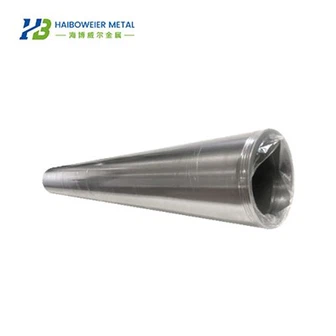
Titanium Tubes for Oil Pipelines
Name: Titanium tube for oil pipeline
Specifications: Nominal diameter (20mm-400mm)
Wall thickness of low-pressure pipe (2.8mm-12.7mm)
Wall thickness of high-pressure pipe (3.7mm-25.4mm) Length (6 meters 9 meters 12 meters)
can be customized according to the size
Material: pure titanium and titanium alloy (Ti-6Al-4V, Ti-5Al-2.5Sn)
Product Introduction
According to a foreign survey, as early as the 1980s, foreign countries have begun to use titanium metal tubes for research and application in the petroleum industry. And some Chinese companies have also made some progress in the development of titanium tubing and casing, and some products have initially passed the downhole test.The excellent performance of titanium tube can prolong the service life of the pipeline, reduce maintenance cost, and meet the requirements of environmental protection, which is more economical in the long run.
Name: Titanium tubes for oil pipelines
Specifications: Nominal diameter (20mm-400mm) Wall thickness of low-pressure pipe (2.8mm-12.7mm) Wall thickness of high-pressure pipe (3.7mm-25.4mm) Length (6 meters 9 meters 12 meters) can be customized according to the size
Material: pure titanium and titanium alloy (Ti-6Al-4V, Ti-5Al-2.5Sn)
Things to pay attention to when installing titanium pipes for oil pipelines in petrochemical and other fields
1. Titanium pipes for oil pipelines are pipeline systems used to transport fluids such as oil and natural gas. When cutting titanium pipes for oil pipelines, low-speed mechanical methods should be used, and special titanium grinding wheels should be used to avoid flame cutting.
2. Inert gas shielded welding or vacuum welding should be used for welding titanium alloy welded pipes, avoid oxyacetylene welding or carbon dioxide gas shielded welding, and ordinary manual arc welding should not be used.
3. During the installation process, avoid using iron tools and materials to knock and squeeze carbon steel brackets and hangers. At the same time, rubber sheets or soft plastic sheets should be laid between titanium pipes for oil pipelines to avoid direct contact.
4. When processing titanium alloy pipe elbows and pipe bends, low-speed mechanical methods should be used, and special titanium alloy pipe processing equipment should be used.
5. When connecting titanium alloy pipes, pipe fittings that match the pipe material should be used, such as titanium alloy pipe fittings or annealed steel pipe fittings, and connection methods that damage metal properties such as flanging and welding should be avoided.
6. When installing titanium pipes for oil transportation, avoid hitting and squeezing with iron tools and materials. Rubber plates or soft plastic plates should be placed between carbon steel hangers and titanium and titanium alloy pipes to avoid direct contact.
7. When the oil pipeline passes through walls and floors, casings should be installed, the gap should not be less than 10mm, and insulators should be filled, and iron impurities should not be contained in the insulators.
In addition, pay attention to safety and hygiene during the installation process, abide by relevant regulations and standards, and ensure the safety of workers and the environment. If necessary, it is recommended to consult a professional engineer or an expert in the relevant industry.
Welding method of titanium pipe for oil pipeline:
The welding method of titanium pipes for oil pipelines should be argon tungsten arc welding. Welding equipment is DC argon arc welding machine with stable performance, which is Y0300TSP Panasonic welding machine with high-frequency arc ignition and current attenuation device. The welding material should be TA2 (gr2) titanium wire of the same quality as the titanium pipe base material .
Advantages of titanium tubes for oil pipelines:
1.Its lower density can significantly reduce string loads, especially in ultra-deep oil well tubing.
2.Titanium tubes have high strength, including the specific strength of different materials such as elongation strength, creep strength, and fatigue strength at different temperatures.
3.Titanium tubes have excellent corrosion resistance, especially seawater corrosion resistance.
4.The use temperature range of titanium tube is wide, and the use temperature of conventional titanium alloy can reach minus 269°C to minus 600°C.
5.Titanium tube has large elastic deformation capacity, and titanium metal material has high yield strength and low elastic modulus, so it is very suitable for parts such as springs, and more importantly, it is suitable for large-displacement horizontal wells.
6.Titanium tubes have a low coefficient of expansion, which makes petroleum equipment more adaptable to temperature changes and reduces the internal stress of structural parts.
7.Titanium tubes are non-magnetic and can meet the requirements of normal use of some detection and communication control means in various equipment.
8.Titanium tubes have good processing performance, usually have good casting, forging, welding, 3D printing and other process performance, which is often an important factor in the selection process of various projects.
Combining the above , the advantages of titanium pipes in the application of oil pipelines are mainly reflected in their good comprehensive mechanical properties and high reliability.


Hot Tags: titanium tubes for oil pipelines, China titanium tubes for oil pipelines manufacturers, suppliers, factory, Titanium coil tube, Titanium Tubes for Oil Pipelines, Titanium Extrusion Tube, Spinning Titanium Tube, GR12 Titanium Tube, Titanium Tube for Bicycle
You Might Also Like




Send Inquiry
