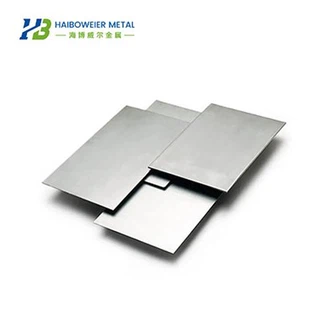
Different uses of titanium and titanium-titanium alloys
Titanium is a chemical element with the symbol Ti and atomic number 22. The density of titanium is 4.54g/cm3, which is 43% lighter than steel. It is higher than aluminum, but lower than steel, copper and nickel. Its specific strength ranks first among metals.
It is a shiny transition metal known for its high strength, low density, good corrosion resistance, and good plasticity and weldability.
Due to its favorable properties, titanium is commonly used in a wide range of applications, including aerospace, automotive, medical implants, and sports equipment.
Titanium alloy, on the other hand, is a material that uses titanium as its base metal but is mixed with small amounts of other elements to alter its properties. These alloying elements may include elements such as aluminum, vanadium, molybdenum, etc., depending on the desired properties of the alloy
According to the impurity content, titanium is divided into high-purity titanium (purity up to 99.9%) and industrial pure titanium (purity up to 99.5%). There are three grades of industrial pure titanium, which are represented by TA + serial number numbers 1, 2, and 3. The larger the number, the lower the purity. Ti: 4.507 g/cm3, Tm: 1688℃. It has allotropic transformation, with α phase of close-packed hexagonal structure at ≤882.5℃, and β phase with body-centered cubic structure at ≥882.5℃. Pure titanium has low strength, but high specific strength, good plasticity, good low-temperature toughness, and high corrosion resistance. Titanium has good pressure processing performance but poor cutting performance. Titanium can burn when heated in nitrogen, so titanium should be protected by argon when heating and welding.
Purpose of pure titanium: The impurity content has a great influence on the performance of titanium. A small amount of impurities can significantly improve the strength of titanium. Therefore, the strength of industrial pure titanium is high, close to the level of high-strength aluminum alloys, and is mainly used to manufacture petrochemical heat exchangers, reactors, ship parts, aircraft skins, etc. with operating temperatures below 350°C.
Titanium alloys refer to various alloy metals made of titanium and other metals. The density of titanium alloys is usually about 4.51g/cm3, which is only 60% of the density of steel. Titanium alloys have high strength, good corrosion resistance, and heat resistance. Titanium alloys only account for 60% of steel, and the strength of some high-strength titanium alloys exceeds the strength of many alloy structural steels. Titanium alloy is made by adding al, mo, cr, sn and other chemical substances on the basis of pure titanium. It is precisely because of these chemical substances that the properties of the two titanium metals are different. Alloys are often used in more demanding or specialized applications where pure titanium may not possess the desired properties.
The difference between titanium and titanium alloys
When deciding to use unalloyed commercially pure titanium or one of its alloys, manufacturers will consider basic factors such as strength and corrosion resistance. Mechanical properties such as density, fatigue crack growth rate and fracture toughness will determine alloy composition and the need for heat treatment.
For corrosion applications, pure titanium is usually preferred because of its lower strength. Such applications can include heat exchangers, storage tanks and reaction vessels for a variety of industries and sectors, including power generation, chemical processing and desalination.
When it comes to high performance applications, higher strength titanium alloys are used. These are used in the development of gas turbines and various aircraft structures, as well as submersibles and drilling equipment. Today, titanium alloys are also used in the manufacture of biomedical implants and bicycle parts (frames).
Alloys such as Ti-6Al-4V and Ti-3Al-8V-6Cr-4Mo-4Zr are used in offshore drilling applications and geothermal pipelines. Other alloys, including Ti-6V-2Sn-2Zr-2Cr-2Mo+Si, Ti-10V-2Fe-3Al, Ti-6Al-2Sn-4Zr-2Mo+Si, are used in aerospace applications as well as gas turbine engines.