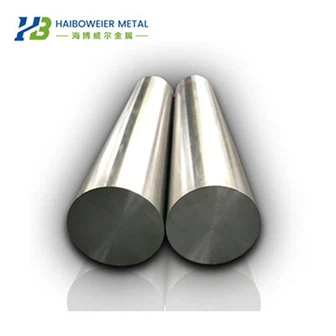
Reversible cold rolling of titanium alloy rods and oxide film removal technology
Reversible rolling refers to the rolling process in which the titanium rod is repeatedly compressed and deformed on the rolling mill to finally obtain the product thickness. The reversible rolling mill equipment is relatively simple and consists of titanium coil conveying and uncoiling equipment, rolling mill, front and rear coilers, and unloading output equipment. Some rolling mills add coilers before or after rolling according to technical requirements.

Cold-rolled raw materials are supplied by hot-rolling units, and a single hot-rolled titanium coil weighs less. The head and tail of the titanium coil can be cut off and welded together on the uncoiler device to increase the production capacity of the cold rolling process.
Hot-rolled titanium rods must be pickled before cold rolling mill. The purpose is to remove the iron oxide scale on the surface of the titanium rod, make the surface of the cold-rolled titanium rod smooth, and ensure the smooth progress of rolling production.
The pickled hot-rolled titanium coils are hoisted from the central warehouse to the saddle of the chain conveyor, and the conveyor chain transports the titanium coils to the uncoiling position in sequence for uncoiling. The extended belt head is introduced into the three-roller straightening machine from the hook head and sent into the roll gap through the movable guide plate. The strip head reaches the exit side coiler through the raised or closed roller gap, is inserted into the jaws of the reel, and is tightened. According to the thickness of the titanium rod, after a few turns, adjust the pressure and tension, and then press down the pressure guide plate to roll. Apply rolling fluid, start the rolling mill, increase the speed to normal speed according to the rolling conditions, and perform the first pass of rolling.
When the titanium coil is about to be rolled, the rolling mill must slow down and stop in time so that the tape tail stops on the entrance side coiler drum. After the coiling pliers bite off the tail of the strip, the titanium rolling mill assigns the second pass of pressing according to regulations. The operator selects the tension, supplies rolling fluid, and the mill performs reverse rolling.
Depending on the titanium grade and standard, 3 to 7 passes of reciprocating rolling are performed in each pass. When the reciprocating rolling reaches an odd number of passes and reaches the product thickness, the roll gap is raised or closed and the tail is springed according to the quality of the strip tail. On the reel of the coiler, the tape tail is welded to the outer titanium coil or taped. The titanium coil is transported from the roll by the unloading trolley, and then dumped into the titanium coil collection tank, and the coil is marked. According to standards, it can be upgraded to subsequent processes to continue production.
Titanium rod oxide film removal technology
In industrial production, the degree of oxidation of titanium alloy rods may vary greatly. If the previous process is severely oxidized, such as severe oxidation under high temperature conditions and the formation of oxide scale, sandblasting must be performed. The workpiece after sandblasting needs to go through subsequent processes (alkali cleaning, pickling). If the oxide film is thin and sandblasting is not required, it can be pickled directly.

Titanium dioxide is an amphoteric compound with slightly greater alkalinity than acidity. Titanium dioxide is very thermally stable and will only decompose at very high temperatures. It is also chemically stable and at lower temperatures it has good stability in many inorganic and organic media. Insoluble in water and many other solvents, insoluble in various dilute acids except hydrofluoric acid. Diamond dioxide is also insoluble in concentrated sulfuric acid. However, titanium dioxide is soluble in hot concentrated sulfuric acid, nitric acid and sodium hydroxide solutions, and can be used for alkali cleaning and pickling of titanium screws and titanium alloy rods.
The alkali cleaning of titanium alloy rods, including other rare metals, is carried out in molten alkali solution. The purpose is to remove the oxide scale on the surface of the titanium alloy rod on the surface of the workpiece. The action of alkaline solution and oxide scale can remove oxide scale. However, in order to remove the oxide scale on the workpiece surface while avoiding its side effects, it is necessary to measure the oxidant (NaNO3 or KNO3) in the NaoH melt.
The main parameters that affect the alkali cleaning process are the alkali solution composition, alkali cleaning temperature and time.
The selection of alkali components mainly considers how to inhibit the hydrogen absorption process of titanium during alkali cleaning. Titanium screws and titanium alloy rods can release hydrogen during alkali cleaning, which provides the possibility of hydrogen absorption. Hydrogen absorption can cause hydrogen embrittlement, and the composition of the alkali solution has a significant impact on the amount of hydrogen absorption. The addition of certain ingredients other than sodium hydroxide has a significant impact on hydrogen absorption and metal loss during alkali cleaning of titanium alloy rods.