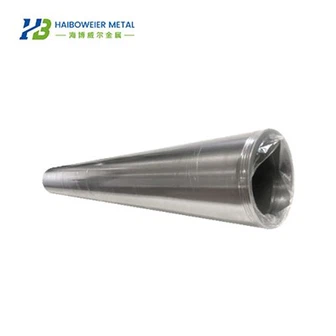
Titanium wire rolling process
The raw materials required for titanium wire rolling are titanium ingots, which are made into titanium rods through heating, melting, casting, forging and other processes. Titanium rods have the advantages of high strength, corrosion resistance, and good biocompatibility, and are widely used in aviation, medical, chemical and other fields.
First, the titanium rod is processed into a billet of a certain size and shape by cutting, grinding, etc., for rolling. During the processing, attention should be paid to preventing oxidation and contamination of the titanium alloy to ensure the smoothness and quality of the blank surface. Select appropriate rolling equipment according to the size and shape of the billet, including hot rolling mills and cold rolling mills. The hot rolling mill is suitable for the situation where the billet diameter is larger and the material is softer, while the cold rolling mill is suitable for the case where the billet diameter is smaller and the material is harder.
Before starting rolling, check the operation status of the equipment to ensure that the surface of the roll is smooth and free of foreign matter, and adjust the distance between the rolling mills to a suitable position. Put the billet into the rolling mill and adjust the position of the billet to ensure that the rolling center line coincides with the roll center line. Start the rolling mill, roll at a certain speed, and gradually increase the number of rolling passes until the required thickness is reached.
During the rolling process, we must always pay attention to changes in billet temperature and rolling force, and adjust rolling speed and temperature in time to ensure rolling quality.
The optimum temperature range for titanium wire rolling is 800°C~1200°C, too high or too low temperature will affect the mechanical properties and dimensional accuracy of titanium wire. Therefore, during the rolling process, equipment such as thermometers must be used to monitor and control the billet temperature in real time.
The speed of rolling directly affects the thickness and mechanical properties of titanium wire. Too fast speed will cause uneven thickness of titanium wire and reduce product quality; too slow speed will waste production time and energy. Therefore, the appropriate rolling speed should be selected according to the specifications and requirements of the titanium wire.
Titanium wire is easily oxidized and deformed at high temperatures, so appropriate cooling methods are required to reduce the temperature of the titanium wire. Common cooling methods include water cooling, air cooling, spray cooling, etc. According to the specifications and requirements of the titanium wire, select the appropriate cooling method to ensure uniform cooling and stable performance of the titanium wire.
Precautions
Avoid frequent downtime during the rolling process, so as not to affect product quality and production efficiency.
When shutting down, make sure that the roll is in an idle state to avoid the blank being stuck in the roll.
Operators must undergo professional training to master safe operating procedures and equipment maintenance methods.
Regularly inspect and maintain the equipment to ensure the normal operation of the equipment.
In short, the titanium wire rolling process requires knowledge of raw material preparation, titanium rod processing, equipment selection, operating methods, temperature control, speed control, cooling methods, etc. By continuously optimizing process parameters and strengthening equipment maintenance, product quality and production efficiency can be improved to meet market demand.