


What is the relative atomic mass of titanium?
In the microscopic world of chemistry, elements are like stars, each with its own unique identity and properties. Among them, titanium, as a lightweight, corrosion-resistant, high-strength metal, is widely used in aerospace, medical, chemical and other fields. However, have you ever been curious about the relative atomic mass of this magical metal, titanium? Today, let us unveil the mystery of titanium and explore the mystery of its relative atomic mass.

1. Relative atomic mass of titanium
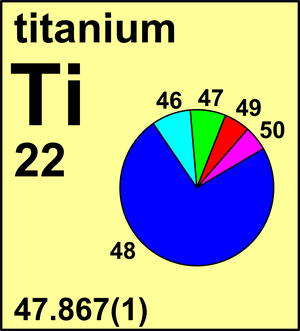
Relative atomic mass is an important physical quantity in chemistry. It represents the ratio of the atomic mass of an element to 1/12 of the atomic mass of carbon-12. After precise measurements by scientists, its relative atomic mass is about 47.87. This seemingly simple number actually contains the basic characteristics of the mass of titanium atoms and is an important parameter for understanding and applying the element titanium. It is with these precise data that we can better understand the properties and uses of titanium and contribute to the scientific and technological progress of mankind.
2. Titanium isotopes
The relative atomic mass of titanium is not a fixed value, but varies according to different isotopes of titanium. Isotopes refer to different atoms of the same element with the same number of protons but different numbers of neutrons. Titanium isotopes include Ti-46, Ti-47, Ti-48, etc., and their relative atomic masses are 45.95, 46.94 and 47.95 respectively. These isotopes are distributed in different proportions in nature, which affects the overall relative atomic mass of titanium.
3. Application of titanium
Due to the small relative atomic mass of titanium and its relatively compact atomic structure, titanium has extremely high strength and hardness. Titanium is about 40% lighter than steel, but its strength is comparable to that of steel! At the same time, the density of titanium is relatively small, with a density of only 4.51 g/cm3, which makes it an ideal lightweight material. In the field of aerospace, titanium is widely used in the manufacture of shells and structural parts of spacecraft such as aircraft and rockets, greatly reducing the mass of spacecraft and improving its flight performance.
4. Extraction method of titanium
Titanium is quite abundant in the earth's crust, but it is difficult to extract directly from the ore due to its active chemical properties. At present, the industry usually uses the Claus method or molten salt electrolysis method to prepare titanium metal. Although these methods are complicated and costly, it is these efforts that have made titanium, a precious metal, widely used in various fields.
Although the relative atomic mass of titanium is just a simple number, it contains the basic characteristics of the quality of titanium and the possibility of wide application. With the continuous development of science and technology, the application field of titanium is also expanding. From traditional aerospace and biomedical fields to emerging energy and environmental protection fields, titanium has shown great potential and value. In the future, we have reason to believe that titanium will continue to play an important role in the stage of chemistry and materials science.


