


Why must rocket engines use titanium forgings?
As the Long March 5 rocket soars through the sky and SpaceX's Falcon series rockets achieve precise recovery, humanity's exploration of the universe never ceases. In this dialogue with the stars, the performance of the rocket engine determines the success or failure of every flight. Inside the engine, a metal component called titanium forging silently undertakes the most demanding mission-its unique advantages of being lightweight, high-strength, temperature-resistant, and corrosion-resistant make it an indispensable "steel heart" of the rocket engine.
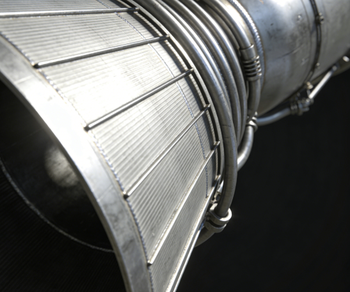
Lightweight and High-Strength: The Technological Secret to "Slimming Down" Rockets
Every gram of weight in a rocket launch is related to cost. Statistics show that every kilogram reduction can save between $22 and $440 in launch costs. The emergence of titanium alloy forgings provides a perfect solution to this problem. Its density is only half that of steel, yet its strength is higher than high-strength steel. Taking the Long March 5 rocket as an example, the use of titanium alloy in its main load-bearing support components reduced its weight by 30%, equivalent to "unloading" several tons of burden from the rocket. This "weight reduction without sacrificing power" characteristic allows rockets to carry more fuel or payload, directly improving the cost-effectiveness of space missions.
The lightweighting of titanium forgings does not come at the expense of strength. Through precise forging processes, titanium alloys form a uniform fine-grained structure, achieving a tensile strength exceeding 1000 MPa, far surpassing ordinary metals. In the turbopump blades of rocket engines, titanium forgings must withstand high-speed rotation at tens of thousands of revolutions per minute and extreme centrifugal forces. Their high strength ensures that the blades do not deform or break during high-speed operation, providing a solid guarantee for stable engine operation.
Temperature and Corrosion Resistance: Guardians Through Extreme Temperatures
The operating environment of rocket engines is described as "hellish": combustion chamber temperatures exceed 3000°C, while the interior of the fuel tank drops to -253°C. Titanium forgings, with their unique physical properties, are the only metallic material capable of simultaneously withstanding extreme high and low temperatures. At high temperatures, a dense oxide film rapidly forms on the surface of titanium alloys, effectively blocking heat transfer and preventing internal structural overheating and failure. At extremely low temperatures, its toughness and ductility actually increase, avoiding the risk of metal embrittlement.
This ability to adapt to both extremes allows titanium forgings to excel in critical engine components. For example, the nozzle ducts of liquid hydrogen-liquid oxygen engines need to be in long-term contact with cryogenic liquid hydrogen; traditional metals would crack due to cryogenic embrittlement, while titanium forgings maintain stable performance. The combustion chamber nozzle extension section needs to withstand the scouring of high-temperature combustion gases; the oxidation resistance of titanium alloys makes its service life far exceed that of other materials. Furthermore, the resistance of titanium forgings to highly corrosive substances such as aqua regia and sulfuric acid solves the problem of long-term storage of rockets in humid or chemically contaminated environments.
Fatigue Resistance and Impact Resistance: Reusable "Space Longevity Stars"
With the rise of commercial spaceflight, rocket recovery technology has become crucial for reducing launch costs. In this process, the fatigue resistance and impact resistance of titanium forgings play a decisive role. Taking SpaceX's Falcon series rockets as an example, their recovery landing legs must withstand impacts of tens of tons. Titanium alloy forgings, through optimized grain structure, increase fatigue strength to more than twice that of ordinary metals, ensuring the landing legs maintain stable performance even after multiple uses.
The impact resistance of titanium forgings is also reflected in the fairing's load-bearing structure. When the rocket passes through the atmosphere, the fairing must withstand the severe vibrations and impacts generated by high-speed airflow. Titanium alloy forgings, through a unique elastic modulus design, effectively absorb impact energy, preventing structural deformation or fracture. This "softness overcoming hardness" characteristic makes titanium forgings the preferred material for reusable aerospace equipment.
From Aerospace to Everyday Life: The Infinite Possibilities of Titanium Forgings
The superior performance of titanium forgings not only serves the aerospace field but also demonstrates enormous potential in fields such as medicine, energy, and marine engineering. In the medical field, titanium alloy artificial bones, with their perfect biocompatibility with human tissue, have become the gold standard for orthopedic implants. In the energy sector, titanium forgings are used to manufacture turbine blades, significantly improving power generation efficiency. In marine engineering, titanium alloy pipes, through optimized grain structure, have achieved a thermal conductivity of 17 W/(m·K), ensuring the efficient operation of seawater desalination systems.
From the "steel heart" of rocket engines to the invisible guardian of daily life, titanium forgings are redefining the performance boundaries of metallic materials with their unique advantages of being lightweight, high-strength, temperature-resistant, and corrosion-resistant. As humanity's exploration of the universe extends ever further, titanium forgings will continue to serve as the cornerstone of aerospace dreams, carrying every breakthrough and transcendence, sailing towards even more distant stars and seas.


