


How Much Pressure Can Titanium Tubes Withstand in High-Temperature Automotive Components?
In the modern automotive industry, the ability of components to withstand high-temperature and high-pressure environments is a crucial indicator of material performance. With the continuous advancement of automotive engine technology, components such as exhaust systems, turbocharger piping, and high-performance fuel systems require materials that simultaneously meet high-temperature resistance and high-strength pressure resistance. Titanium tubes, due to their low density, high strength, corrosion resistance, and oxidation resistance, are gradually becoming an ideal choice for high-temperature automotive components. However, many engineers and enthusiasts ask: How much pressure can titanium tubes withstand under high-temperature conditions? Do their performance meet the high-load operating requirements of engines?
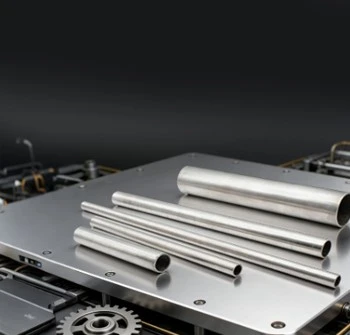
While the strength of titanium metal decreases slightly with temperature, it remains significantly superior to aluminum alloys and ordinary stainless steel. It not only maintains a stable structure in exhaust environments around 500℃ but can also withstand extreme pressure without permanent deformation or fracture. In high-temperature, high-vibration scenarios such as turbocharger exhaust pipes and engine exhaust manifolds, the reliability and service life of titanium tubes have become important factors for designers.
Titanium Tube Basic Pressure Bearing Capacity
Room Temperature Tensile Strength: Commonly used materials for titanium tubes, such as Ti-6Al-4V alloy, have a room temperature tensile strength of approximately 900-950 MPa.
Yield Strength: The room temperature yield strength is approximately 830 MPa, maintaining structural integrity under short-term high-temperature impact.
Comparative Analysis: Compared to aluminum alloys (yield strength approximately 300 MPa) and ordinary stainless steel (approximately 500-600 MPa), titanium tubes have a significant advantage in pressure bearing capacity.
Analysis: Within the operating pressure range of engine exhaust and fuel systems, titanium tubes provide sufficient safety margins, maintaining reliability even in high-speed turbochargers or high-power engines.
Strength Changes at High Temperatures
Effect of Temperature on Strength: In the 400-500℃ range, the tensile strength of titanium tubes decreases by approximately 10-15%, and the yield strength is slightly lower, but still remains at 600-750 MPa.
• Creep Resistance: Under prolonged high temperature and pressure, titanium tubes exhibit low creep rates, making them more suitable for sustained high-temperature applications than aluminum alloys and lower-end steels.
• Application Examples: Turbocharger exhaust pipes using titanium tubes maintain their shape even when exhaust temperatures exceed 450°C.
Analysis: Even in high-temperature environments, titanium tubes still provide pressure resistance far exceeding actual operating pressure, which is crucial for high-load engine operation.
Influence of Tube Diameter and Wall Thickness on Pressure Resistance
· Tube Diameter:
Small-diameter tubes (inner diameter 10~25mm) withstand pressure more evenly under high temperature and pressure, making them suitable for fuel injection systems.
Large-diameter tubes (50mm and above): Pressure resistance depends on wall thickness and tube strength.
· Wall Thickness Influence:
Thin-walled titanium tubes (1~2mm) can withstand approximately 15~20MPa pressure, suitable for lightweight designs.
Thick-walled titanium tubes (3~5mm) can withstand pressures up to 50~70MPa, suitable for exhaust manifolds or turbine piping.
Analysis: When designing titanium pipes, a balance between weight and pressure-bearing capacity must be struck. Appropriate selection of pipe diameter and wall thickness is crucial to ensure lightweight construction while meeting the requirements of high-temperature and high-pressure conditions.
Pressure Resistance under Vibration and Impact
Engine Vibration: During high-speed engine operation, the exhaust system experiences periodic vibrations, requiring the pipe material to resist fatigue failure.
Impact Pressure: Instantaneous high-pressure pulses occur during the exhaust process in the combustion chamber. Titanium pipes, with their strong impact resistance, are less prone to cracking.
Case Study: High-performance racing car engines use titanium exhaust pipes that have withstood thousands of high-temperature and high-pressure cycles while maintaining structural integrity. The high elasticity and strength of titanium pipes ensure safety under long-term vibration conditions, a stability difficult to achieve with aluminum or ordinary steel pipes.
Corrosion and Oxidation Resistance
Strong Oxidation Resistance: Titanium forms a dense oxide film on its surface at high temperatures, withstanding oxidation at 400-500℃.
Chemical Corrosion Resistance: It is not easily corroded when in contact with fuel, engine oil, or exhaust gases, extending the pipe's service life.
Analysis: Chemical corrosion at high temperatures is a major threat to the lifespan of the exhaust system. Titanium tubing exhibits outstanding resistance to oxidation and corrosion, ensuring long-term structural stability even under high temperature and pressure.
Actual Pressure Bearing Limits
Short-term ultimate pressure: Can withstand short-term pressure peaks of approximately 80~100MPa, far exceeding the actual working pressure of conventional engine exhaust and fuel lines.
Long-term continuous working pressure: Can withstand continuous pressure of 15~50MPa at 400~500℃, suitable for turbocharged exhaust and high-pressure fuel systems.
Analysis: The margin between short-term ultimate pressure and long-term working pressure ensures the safety and reliability of titanium tubing under high temperature and pressure environments, providing a sufficient safety margin for engine design.
Titanium tubing performs exceptionally well in high-temperature automotive components. It maintains high strength at both room and high temperatures, with tensile, yield, and impact resistance far exceeding that of aluminum alloys and ordinary steel; its resistance to high-temperature oxidation and corrosion ensures long-term safety; and its reasonable diameter and wall thickness design provides ample safety margins in high-pressure environments. Short-term ultimate pressure and long-term continuous pressure analysis show that titanium tubing not only meets the operational requirements of high-performance engines but also maintains reliability under complex conditions such as vibration, impact, and corrosion. Therefore, in high-temperature automotive component applications such as exhaust pipes, turbine piping, and high-pressure fuel systems, titanium tubing is not merely a gimmick but a performance necessity. Its lightweight advantage combined with high pressure resistance not only improves overall vehicle performance but also extends component lifespan and reduces maintenance frequency, providing reliable assurance for the design of modern high-performance car and racing engine systems.


