


Why Are Titanium Alloys Used in Aerospace High-Pressure Gas Cylinders?
In aerospace systems, high-pressure gas cylinders are widely used in propulsion systems, attitude control, life-support systems, and gas storage applications. Their safety and reliability directly impact the stability of the entire system. Under extreme pressure, drastic temperature changes, and complex operating conditions, traditional materials often struggle to balance strength, weight, and durability. Titanium and titanium alloys, with their outstanding comprehensive properties, have become a preferred material choice for aerospace high-pressure cylinders. Their application not only enables lightweight design but also significantly enhances safety and reliability, providing strong support for advanced aerospace engineering.
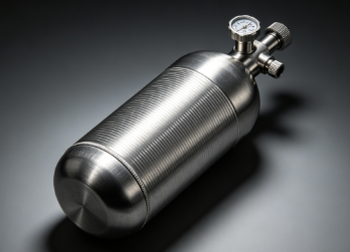
High Strength-to-Weight Ratio Balances Weight Reduction and Pressure Resistance
Weight reduction is a critical factor in aerospace engineering.
- Titanium alloys offer exceptional strength-to-weight performance, reducing cylinder weight while maintaining high pressure resistance
- Compared to traditional steel cylinders, they significantly lower overall mass and improve flight efficiency
- Maintain structural stability under high-pressure conditions without plastic deformation
- Enable optimized structural design that balances lightweight construction with high strength
This advantage makes titanium alloys a key material for lightweight high-pressure cylinder design.
Excellent Fatigue Resistance Ensures Long-Term Safety
High-pressure cylinders undergo repeated pressurization cycles, requiring durable materials.
- Titanium alloys provide strong fatigue resistance, handling repeated pressure cycles effectively
- Reduce the risk of fatigue cracks during long-term use
- Maintain performance with minimal degradation over time
- Improve overall safety by lowering the risk of material failure
These properties are essential for ensuring long-term operational stability in aerospace systems.
Corrosion Resistance and Environmental Adaptability Improve Reliability
Aerospace environments demand materials with high stability and resistance.
- Titanium alloys form a dense oxide layer that protects against corrosion
- Maintain stability in humid, saline, and various gas environments
- Resist performance fluctuations under temperature variations
- Adapt to complex operating conditions, enhancing system reliability
This environmental adaptability gives titanium alloys a clear advantage in aerospace applications.
Structural Stability and Machinability Meet High-End Requirements
High-pressure cylinders require precision, stability, and reliable sealing performance.
- Titanium alloys maintain dimensional stability under temperature changes
- Suitable for precision machining to meet complex structural designs
- Provide sufficient rigidity to ensure sealing performance
- Enhance overall structural safety and operational stability
- Support customized manufacturing for different aerospace applications
These characteristics make titanium alloys highly competitive in advanced cylinder manufacturing.
As aerospace technology continues to advance, the demand for high-performance materials is increasing. Titanium and titanium alloys, with their high strength-to-weight ratio, excellent fatigue resistance, superior corrosion resistance, and strong structural stability, demonstrate irreplaceable value in high-pressure gas cylinder applications. They not only achieve an ideal balance between weight reduction and pressure resistance but also significantly improve safety and reliability. In the future, titanium alloys will play an even more important role in aerospace systems and high-performance engineering.


