


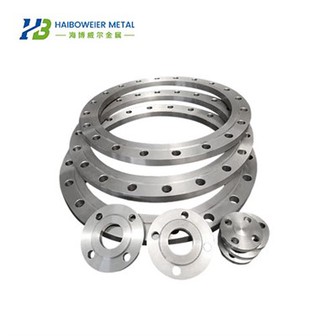
Titanium Flange
A flange is an element that connects pipes, valves, equipment, or other components, and it is usually a flat or circular ring-shaped structure made of metal, plastic, or other materials.
Flanges usually have round, square or other shapes, and their main function is to connect different bolts together by bolts or screws to ensure the tightness and sealing of the connection.
Product Introduction
Product Name: Titanium Flange
Grades: Grade1, Grade2, Grade5, Grade7, Grade9, Grade12
Executive standard: ASTM B348, ASTM B381, ASTM F67
Specifications and sizes: non-standard products accept drawing customization
Delivery status of titanium flange: R o r M
Titanium flange classification:
1. According to chemical industry standards, flanges are divided into: plate type flat welding flange (PL), neck flat welding flange (SO), neck butt welding flange (WN), integral flange (IF), Socket welding flange (SW), threaded flange (Th), butt welding ring loose flange (PJ/SE), flat welding ring loose flange (PJ/PJ), flange cover (BL), lining Flange Cover(BL(s))
2. Classified according to the connection method: welding flange, threaded flange, sliding flange, blind flange (blind flange)
3. According to the petrochemical (SH) industry standard, flanges are divided into: threaded flange (PL), butt welding flange (WN), flat welding flange (SO), socket welding flange (SW), loose Sleeve flange (LJ), flange cover (not shown)
4. According to the mechanical (JB) industry standard, flanges are divided into: integral flange, butt welding flange, plate type flat welding flange, butt welding ring plate type loose flange, flat welding ring plate type loose flange, Flange ring plate loose flange, flange cover
Manufacturing process of titanium flange:
a. Material preparation: Select the appropriate titanium alloy material, cut, forge or cast according to the required flange specifications and characteristics, and obtain the original blank of the required shape and size.
b. Processing points: Preparatory work for the original blank before processing, including surface cleaning, oxide layer, etc., to ensure the smooth progress of subsequent processing procedures.
c. Processing: Precisely process the original blank by using mechanical processing tools (such as machine tools, lathes, drilling machines, etc.), and process it into details such as the shape of the flange and the inner hole.
Hole machining and thread machining: Holes and threads are machined on the flange to connect the flange with components such as pipes and valves. These holes and threads require precise location and dimensions to ensure the precision and tightness of the connection.
d. Heat treatment: In some cases, the processed flange needs to be heat treated to eliminate free radicals, improve the strength and corrosion resistance of the material.
e. Welding: For welded flanges, the flanges of different parts are joined together by welding techniques, usually by gas shielded welding (TIG welding) or other suitable welding methods.
Surface treatment: Treat the flange surface, such as polishing, sandblasting or pickling, to improve appearance and provide better corrosion resistance.
f. Quality inspection: Strict quality inspection is carried out on the finished flange, including size, shape, hole accuracy and sealing, to ensure that the product meets the requirements of standards and specifications.
Marking and backup: mark the flanges that have passed the quality inspection, including flange specifications, materials and other information, and then carry out proper packaging to prevent damage during transportation and storage.
g. Delivery: Delivery of manufactured third party to customer, supply chain or project site for installation and use.
It should be noted that, as a special metal material, titanium's processing and welding process may be relatively complicated, requiring special equipment and technology. The manufacture of titanium alloys requires strict compliance with material characteristics and process requirements in order to ensure the quality of the final product. Different manufacturers and factories may have differences in manufacturing, resulting in different demand processes and standards.
Flange production standard
|
National standard |
American Standard |
Ministry of Chemical Industry Standard |
Machinery is not standard |
Pressure Vessel Standard |
petrochemical standard |
|
GB/T9112-2010 |
ASTM B16.5 |
HG20592-2009 series |
JB81-59 |
NB/T7021~47023-2012 |
SH/T3406-1996 |
|
(GB99113.1-2010~ |
TSTM B16.47 |
HG20615-2009 series |
JB/T79-94 |
||
|
GB9123.4-2010) |
|
|
JB/T86-94 |
||
|
|
|
|
JB/T74-1994 |
Titanium Flange System /Standard
|
|
European flange system |
American Flange System |
Domestic Standard System |
|
system standard |
German DIN series (including Russian OCT) |
American ANSI B16.5 ANSI B16.47 |
GB/T911GB/T9112-2000 (GB9113·1-2000~GB9123·4-2000) HG/T20592-2009 |
|
Nominal pressure |
0.1, 0.25, 0.6, 1.0, 1.6, 2.5, 4.0, 6.4, 10.0, 16.0, 25.0, 32.0, 40.0Mpa |
150psi (2.0Mpa), 300psi (5.0Mpa), 400psi (6.8Mpa), 600psi (10.0Mpa), 900psi (15.0Mpa), 1500psi (25.0Mpa), 2500psi (42.0Mpa) |
PN2.5 PN10 PN16 PN25 PN40 PN63 PN100 PN160 |
|
Flange structure |
Flat welding plate type, flat welding ring loose sleeve type, curling loose sleeve type, butt welding curling loose sleeve type, butt welding ring loose sleeve type, butt welding type, neck threaded connection type, integral type and flange cover |
Bar welding, socket welding, threaded connection, loose sleeve, butt welding and flanged cover |
Integral flange, unit flange (threaded flange, welding flange, butt welding flange), neck flat welding flange, neck socket welding flange plate flat welding flange, loose sleeve flange butt welding ring loose Sleeve neck flange, butt welding ring loose sleeve flange, flat welding ring loose sleeve flange, plate flipped loose sleeve flange, flange cover, swivel flange, anchor flange, overlay welding/overlay welding method orchid |
|
Sealing surface form |
Flat surface, concave surface, concave-convex surface, tongue and groove surface, rubber ring connection surface, lens surface and diaphragm welding surface |
Concave surface, concave-convex surface, tongue and groove surface, metal ring connection surface |
Flat surface, concave surface, concave-convex surface, tongue and groove surface, ring connection surface |
The use of titanium flange
1. Connectivity: Flanges are widely used to connect pipes, valves, equipment, etc. to form a complete system. This connection allows nodes in the system to be sensored and replaced, facilitating maintenance and repair.
2. Sealing: The flange connection is supported by bolts or bolts, and the contact surface of the flange is usually equipped with a gasket or a sealing ring to ensure good sealing of the connection and prevent leakage of liquid, gas or other fluids.
3. Various types: Flanges can be divided into different types according to their uses and connection methods, such as sliding flanges, threaded flanges, welding flanges, blind flanges, etc.
Application of titanium flange:
Due to its excellent corrosion resistance, high strength and light weight characteristics, it is widely used in many special industrial fields.
Chemical industry: Titanium flanges are widely used in the chemical industry, especially in piping systems involving liquid media, strong acids, strong alkalis, etc. Titanium flanges can withstand a variety of anti-corrosion substances, ensuring the stability and durability of the piping system.
Ocean engineering: It is applied in ocean engineering such as offshore platforms, submarine pipelines, and ships. Due to the shallow corrosion of titanium metal to seawater, titanium flanges can maintain stability in marine environments for a long time.
Aerospace: Due to its light weight and high strength, it is often used in the aerospace field. It can reduce the weight of aviation equipment such as airplanes and rockets, thereby improving fuel efficiency and performance.
Medical devices: Titanium metal has good compatibility with human tissue, so titanium flanges are used in the manufacture of medical devices, such as orthopedic intakes, artificial joints, etc.
Oil and gas: Titanium flanges are used in the oil and gas field for the connection of pipes, valves and other equipment. They maintain stability in high temperature and high pressure environments while resisting fire fighting gases and liquids.
Food processing: Its corrosion-resistant and biocompatible devices are used in the food processing industry to connect pipes and equipment to ensure food hygiene and quality.
Fertilizer production: Some production processes in the fertilizer industry involve media such as strong acids and alkalis, and titanium flanges can maintain stability in these gradient environments.
In general, titanium flanges are widely used in industrial fields that require corrosion resistance, high strength and light weight characteristics.


Hot Tags: titanium flange, China titanium flange manufacturers, suppliers, factory, Titanium Flange, Titanium Forgings, Titanium BL Flange, Titanium WN Flange, Titanium Blind Flange
You Might Also Like




Send Inquiry
