


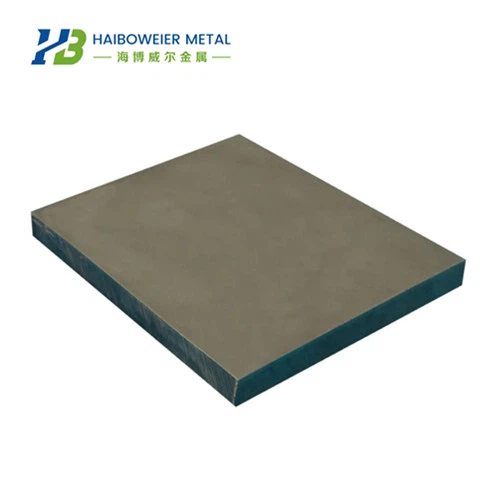
Titanium Composite Steel Plate
Name: Titanium composite steel plate
Material: steel plate and titanium alloy plate
Processing method: explosion, crimping, hot rolling method
Processing temperature: 850℃
Product specifications: Thickness: >3mm, cladding thickness : 1mm~6mm, base layer thickness : >2.5mm
width: 1500mm~2600 mm length: <12000mm
Characteristics: cold working - warm working - hot working forming and weldability .
Applications: heat exchangers, pressure vessels, chemical vessels, etc.
Product Introduction
Titanium composite steel plate is an important part of our company's composite metal business. We have thousands of tons of composite titanium steel plates, 70% of which are exported. We mainly produce titanium steel composite panels through explosive coating. From the selection of raw materials to the interior and exterior of the finished product , strict implementation of standard requirements in all production links such as inspection is an important reason for our long-term stable quality and increased order volume. Strictly control every processing and production detail to meet your requirements for technology and product quality.
Manufacturing method:
|
The general manufacturing methods of composite steel wrenches include: filled metal ingot rolling method, explosive film method, rolling method, surfacing method, etc. In order to consider the performance of titanium, the industry mainly uses explosive compounding or rolling layering methods. The actual production methods are: ① Explosive compounding method, rolling bending method ② Thick plate rolling method ⑤ and continuous rolling. Usually, the compounding, rolling and bending method of explosive materials at room temperature is to assemble, heat and roll the plates. |
|
|
Explosives reconstitution |
The key points of the explosive compounding method are: first keep a certain distance between the two metal plates, and then place an appropriate amount of explosive on them. It is detonated by one end of the explosive and explodes at speeds of several kilometers per second. In order to obtain the explosive energy, the titanium plates collide starting from the angle of the base steel plate. At the point of impact, the base steel plate and titanium plate exhibit fluid behavior due to the very large deformation speed and ultra-high pressure. The oxide film and gas adsorption layer between the two metal surfaces are removed, and a clean surface between the surfaces is instantly completed. This is the so-called cold bonding. Therefore, it is also called explosion coating method. |
|
Thick plate rolling method |
The thick plate rolling method initially assembles titanium plates (CATE) and steel plates (murabot) into embedded plates. A suitable intermediate material is placed between the titanium plate and the steel and then welded using an electron beam under high vacuum. Finally, after heating in the heating furnace, it is rolled on the thick plate rolling mill to the required thickness to truly connect the titanium plate and the steel plate. Finally cut it into two planks. |
|
Continuous hot rolling |
The thick plate rolling method is also a continuous hot rolling method. The difference is that a steel plate is added between the two steel plates, arc welding is performed in the atmosphere, and finally the strip coil is continuously rolled to the required thickness by a continuous hot rolling mill. Ready to go. Finally cut it into two planks. |
|
Application areas |
Titanium steel composite plates produced by explosion method and thick plate rolling method are thick plates and are mainly used as corrosion-resistant structural materials. The power generation equipment uses chemical equipment such as high-purity parabenzoic acid equipment and condenser sections. The titanium steel composite plate produced by continuous hot rolling is a thin plate. Thin plates are mainly used in marine steel structures and marine civil engineering. |
Chemical composition:
Both cladding and base layers are verified by sample analysis in the ladle. Titanium content analysis can be performed as needed. The analysis of samples in ladles can be specified in the corresponding standards. However, sample collection methods are not standardized when analyzing multilayered titanium, so details in this area are best negotiated between manufacturer and user.
Mechanical properties :
Composite panels are composed of dissimilar steel plates. There are two methods for determining tensile strength: taking the total thickness as the base layer and determining the standard value based on the combined thickness. However, when the cladding is a titanium plate, it is difficult to weld dissimilar materials, and the standard value determined based on the thickness of the composite material cannot be used. Therefore, just like the lining, only the base layer is used as the object of composite panel strength calculation, without considering the mechanical properties of the composite panel. However, the structure of the welded joint generally requires a special structure different from that of the lining for reinforcement .
Titanium steel plate welding:
First weld the base metal weld, and clean the root of the weld after welding until a dense weld metal appears. Then weld the back weld of the base metal from the cladding side; after welding, repair the back of the weld so that it is flush with the base plate.
Install filler material in the trench created between the base and cladding.
Install the titanium cover plate to the appropriate position, and use TIG welding to perform fillet welding between the titanium cover plate and the titanium surfacing parts. The second process for welding titanium composite steel plates is to insert a thin layer of refractory metal lining, such as 0.1mm thick niobium foil or molybdenum foil, into the titanium-coated groove. When welding titanium steel composite plate cladding, TIG welding can be used and titanium wire can be added. The diameter of the titanium wire depends on the cladding and groove form of the titanium steel composite panel. When welding, the tungsten arc should be burned between the welding wire and the tungsten electrode. Do not allow the arc to act directly on the niobium foil. The welding gun should move along the titanium wire. After the titanium wire is melted, the weld seam of the titanium steel composite plate is formed. Since niobium has a high melting point and the tungsten arc does not directly act on the niobium foil, only a small part of the niobium melts, preventing titanium and steel from fusing with each other, effectively preventing the formation of brittle phases.
Titanium composite steel plate inspection and surfacing repair
The inspection equipment includes ultrasonic thickness gauge and ultrasonic flaw detector. The measurement position is generally at the intersection of straight lines drawn at 200mm intervals in the length and width directions, or on both sides of the straight line. Specific details are best determined by negotiation between manufacturer and user.
For local spalling found by ultrasonic flaw detection, special welding methods (such as silver brazing) can be used to repair the titanium surfacing layer. Due to the difficulty of welding dissimilar materials (base layer), it is stipulated that surfacing repair cannot be used.
Composite panels with welds on the cladding will deform when the cladding is welded; spalling will occur at the welds during processing and shaping. Therefore, deformation must be reduced so that non-fitting parts do not peel off.
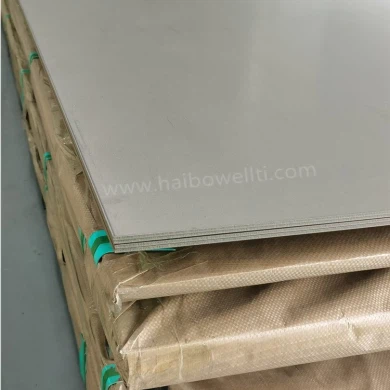
Product Image


Hot Tags: titanium composite steel plate, China titanium composite steel plate manufacturers, suppliers, factory, Titanium Ribbon, Cold Rolled Titanium Plate, Hot Rolled Titanium Plate, Gr7 Titanium Plate, Titanium Coil Plate, 6 4 Titanium Sheet
You Might Also Like


Send Inquiry
