


Can titanium cups be microwaved
In our fast-paced modern lives, microwave ovens have become essential kitchen appliances due to their efficient heating capabilities. However, attempting to microwave a titanium cup can damage the appliance or even cause a fire. This conflict stems from a misconception about the physical properties of titanium. While titanium cups are known for their high-temperature and corrosion resistance, their metallic properties fundamentally conflict with the working principles of microwave ovens.
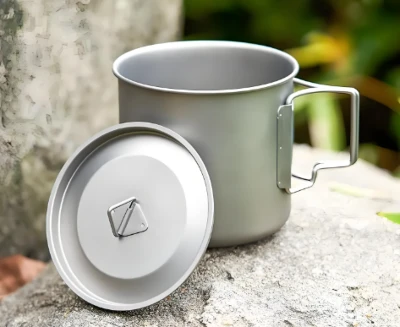
Potential Risks of Arc Discharge
Microwave ovens generate heat by emitting 2.45GHz microwaves that vibrate water molecules in food. Metal surfaces reflect these microwaves, inducing a current. When a conductor like a titanium cup is placed in a microwave, the concentrated current generates a high-temperature arc (commonly known as a "spark") on its surface. This arcing can, at best, burn through the microwave's magnetron, causing equipment failure; at worst, it can ignite plastic components inside the microwave, causing a fire.
Although titanium has excellent electrical conductivity (resistivity of approximately 420 nΩ·m), this very property can become a hazard in microwave ovens. Experimental data shows that when a titanium cup and a ceramic cup are placed in a microwave oven for 30 seconds, the surface temperature of the titanium cup reaches over 200°C, while the ceramic cup only reaches 50°C. This intense energy reflection significantly increases the damage rate of internal microwave components, and some users have reported problems such as unusual noises and device startup failures.
Demarcation of Application Scenarios
Titanium has a melting point of 1668°C and maintains stable performance within a temperature range of -253°C to 600°C, making it an ideal material for outdoor water heating and high-temperature disinfection. For example, a pure titanium water cup can withstand direct heat from an open flame. In actual testing, an alcohol stove can boil 450ml of water in 5 minutes without deformation or odor. However, this high-temperature resistance only applies to heat conduction heating in an open environment, which is fundamentally different from the closed electromagnetic heating of a microwave oven.
Special attention should be paid to the limitations of the insulation structure of double-layer titanium cups. While the double-layer vacuum design improves thermal insulation performance (maintaining heat above 60°C for 6 hours), the internal vacuum layer hinders even heat distribution. Forced microwave heating can cause a significant temperature difference between the inner and outer layers, potentially leading to cracks in the cup. Tests show that after two minutes of microwave heating, double-layer titanium cups may develop microcracks on the inner wall due to concentrated thermal stress. Single-layer titanium cups, lacking a vacuum layer for restraint, experience faster crack propagation.
User Misconceptions
Surface Treatment Misleading: Some titanium cups use ceramic coatings or anodizing processes to enhance their appearance, but these coatings can flake off in microwaves. If a user places a titanium cup with detached coating in the microwave, the exposed metal will directly trigger an arc, causing damage to the device.
Capacity and Shape Impact: Large-capacity titanium cups (such as 900ml) generate higher arc intensity in the microwave due to their greater surface area. Tests show that, given the same heating time, the arc energy generated by large-capacity titanium cups is more than twice that of smaller-capacity cups, resulting in more severe damage to the device.
Risk of Residual Liquid: Conductive materials such as tea and coffee stains in the titanium cup can exacerbate arcing. In a laboratory simulation, a titanium cup containing 0.5ml of tea stain produced a sustained arc after heating in a microwave for 10 seconds, while a clean, empty cup took 20 seconds to produce a faint spark.
Alternative Solutions and Safety Recommendations
Open Flame Heating Specifications: Single-layer titanium cups can be heated directly on a gas stove or alcohol burner, but the "three no's" must be followed: no dry heating (avoid cup bottom temperatures exceeding 300°C), no airtight sealing (remove the cup lid during heating), and no sudden cooling (do not pour cold water immediately after heating). With proper operation, a titanium cup can last over 10 years.
Microwave-Safe Container Selection: For quick beverage heating, it is recommended to use a polypropylene (PP) cup marked "microwave safe." It has a temperature resistance range of -30°C to 140°C and does not produce harmful substances. Comparative testing shows that PP cups heat milk 1.8 times more efficiently than titanium cups, without any safety risks. Daily care tips: Titanium cups should be stored in a dry, well-ventilated area, away from direct sunlight, which can discolor the oxide film. Avoid using hard objects like steel wool when cleaning; nanofiber cleaning pads are recommended. When not in use for extended periods, place a desiccant inside the cup to prevent corrosion caused by humidity.
Titanium's exceptional properties have made it a popular choice in aerospace, medical devices, and other fields. However, its metallic properties make it incompatible with microwave ovens. Users should abandon the misconception that "high-temperature-resistant" materials are microwave-safe and instead utilize safer methods such as open flame heating and dedicated containers.


