G.1 pure titanium understanding
G.1 is a pure titanium material that can be used as an industrial metal material or biomedical implant material. G.1 is an α-type pure titanium with high strength and toughness and good compatibility with biological tissues. Application fields: Commonly used in aerospace, chemical industry, metallurgy, electronics, medical and other fields.
effect:
Due to its good biocompatibility and high strength and toughness, G.1 material can be used to make biomedical implant materials such as medical devices and artificial joints. At the same time, G.1 materials can also be used to produce special industrial equipment in the fields of aerospace, chemical industry, etc., such as aircraft, rockets, high-pressure vessels, etc.
Development History:
The research and application of G.1 materials began in the early 1950s. With the increasing demand for high-strength lightweight materials, G.1 materials are widely used in various fields.
G.1 materials can be manufactured through various methods such as metallurgical technology, thermal processing technology, and cold processing technology. Common manufacturing processes include investment casting, forging, extrusion, drawing and stamping.
Specifications and appearance:
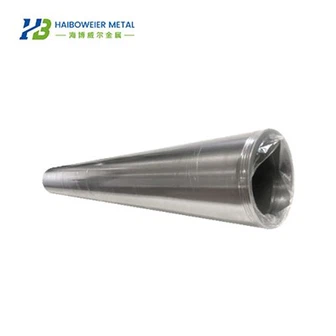
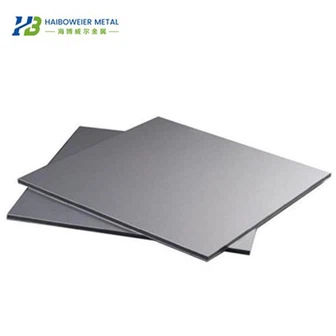
G.1 materials are usually supplied in the form of steel rods, plates, pipes, wires, etc., with various sizes and appearances.
Chemical composition The chemical composition of G.1 material is very pure, reaching more than 99.5%, mainly titanium.
G.1 Chemical properties and mechanical properties table:
|
Chemical composition (%) |
|
|
|||||||||||||||||
|
|
O |
C |
N |
H |
Fe |
Residuals |
AL |
Pd |
Mo |
Ni |
Others |
V |
Ti |
|
|||||
|
GR1 |
0.18 Max |
0.08 Max |
0.03 Max |
0.015 Max |
0.20 Max |
0.4 Max |
|
|
|
|
|
|
Bal |
|
|||||
|
GR2 |
0.25 Max |
0.03 Max |
0.08 Max |
0.015 Max |
0.30 Max |
|
|
|
|
|
|
0.4 Max |
Bal |
|
|||||
|
|
Trademark |
Tensile strength, MPa ( min) |
Yield strength, MPa ( min) |
Elongation, % (minimum value) |
Area reduction rate, % ( min) |
||||||||||||||
|
|
G.1 |
240 |
170 |
twenty four |
30 |
||||||||||||||
|
|
G.2 _ |
345 |
275 |
20 |
30 |
||||||||||||||
Main performance:
It has many advantages such as excellent corrosion resistance, high strength, good plasticity and toughness, and low density. In addition, G.1 material also has the characteristics of anti-wear, low thermal expansion coefficient and high fatigue resistance.

pure titanium :
Brief analysis of physical properties :
It is a group IVB element with an atomic number of 22 and an atomic weight of 47.9. There are two allotropic crystals with a transition temperature of 882.5°C. Below 882.5C, it is hexagonal close-packed a-Ti: the lattice constant (20°C) is:
a=0.295111 nm, c=0.468433nm, C/a=1.5873
882. 5°C~melting point, for body-centered cubic β-Ti: when the lattice constant is at 25C,
a=0.3282nm; a=0.33065nm at 900 °C.
Density is 4.5. Titanium's elastic modulus is low, only half that of iron. The melting point is 1668°C, the electrical conductivity is poor (only 3.1% of copper), the thermal conductivity (one-sixth of iron) and the linear expansion coefficient (similar to glass) are both low. Titanium is non-magnetic and will not be magnetized under strong magnetic fields. Titanium artificial bones and joints implanted in the human body will not be affected by thunderstorms. Titanium has low damping and is suitable as a resonance material. When the temperature is lower than 0.49K, titanium exhibits superconducting properties. After proper alloying, the superconducting temperature can be increased to 9~10K.
Brief analysis of chemical properties :
Titanium is relatively stable at room temperature and very active at high temperatures. In the molten state it can interact with most crucible or modeling materials. Reacts strongly with halogens, oxygen, sulfur, carbon, nitrogen, etc. at high temperatures. Titanium is smelted in vacuum or inert atmosphere, such as vacuum consumable arc furnace, electron beam furnace, plasma furnace and other equipment. Titanium will burn when heated in nitrogen, and titanium dust may explode in the air. Therefore, argon should be used as a protective gas for heating and welding of titanium materials. Titanium can absorb hydrogen at room temperature, and its hydrogen absorption ability is particularly strong above 500°C, so it can be used as a degassing agent for high vacuum electronic instruments. Titanium can be used as a hydrogen storage material by utilizing its hydrogen absorption and release properties.