How to choose between different types of titanium tubes
Titanium tubes, thanks to their lightweight, high-strength, corrosion-resistant, and high-temperature resistance, hold an irreplaceable position in aerospace, marine engineering, chemical engineering, and medical fields. However, faced with two major production methods for titanium tubes: seamless and welded, and different material types such as industrial pure titanium and titanium alloys, choosing the right one becomes crucial.
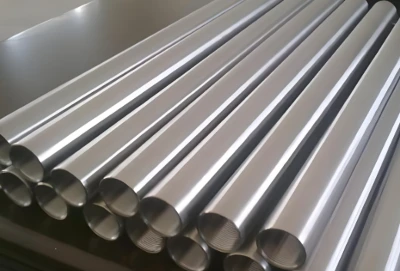
The Process Competitiveness Between Seamless and Welded
Seamless Titanium Tubes
Seamless titanium tubes are manufactured through processes such as extrusion, cold rolling, and spinning. With no weld seams, they offer the following core advantages:
Outstanding Pressure Capacity: The seamless structure avoids stress concentration at welds, allowing them to withstand higher pressures and is suitable for applications such as high-pressure gas storage tanks and deep-sea probes. For example, TC4 titanium alloy seamless tubes boast a tensile strength of 950 MPa and a yield strength of 860 MPa, meeting the demands of extreme operating conditions.
High Dimensional Accuracy: The cold rolling process enables precise control of outer diameter deviations of ±0.15 mm (3-10 mm outer diameter) and wall thickness deviations of ±12.5%, making them suitable for high-precision instrument manufacturing. Stable Corrosion Resistance: No welds mean no heat-affected zones (HAZs), resulting in a uniform oxide film on the material surface, offering excellent performance in corrosive environments such as desalination and chemical pipelines.
Typical Applications: Aerospace engine compressor components, nuclear power plant condensers, and deep-sea oil and gas pipelines.
Welded Titanium Tubes
Welded titanium tubes are produced by coiling titanium strips followed by high-frequency welding or argon arc welding. Their advantages include:
Significant Cost-Effectiveness: Short production steps and high material utilization reduce costs by 30%-50% compared to seamless tubes, making them suitable for mass production. For example, over 80 welded titanium tube production lines have been established in China, with an annual production capacity exceeding 10,000 tons.
Flexible Length Customization: Tube lengths are not limited by process requirements, allowing for the production of tubes exceeding 15 meters in length, meeting the needs of large heat exchangers and building structures.
Optimized Surface Quality: Through W-bending and eddy current testing technology, the weld zone achieves a surface finish that is as smooth as the parent material, making it suitable for transporting food-grade fluids.
Typical Applications: Power plant condensers, desalination evaporators, automotive drive shafts, and bicycle frames.
Performance Differences Between Industrially Pure Titanium and Titanium Alloys
Industrially Pure Titanium: The Cost-Effective Choice
Industrially pure titanium (such as TA1, TA2, and TA3) is based on high-purity titanium and possesses the following properties:
Excellent Corrosion Resistance: The dense surface oxide film protects against corrosion from seawater, chloride ions, hydrogen sulfide, and other factors, resulting in a lifespan exceeding 20 years in marine engineering applications.
Excellent Biocompatibility: Compliant with ISO 10993 biosafety standards, it is widely used in medical applications such as artificial joints and dental implants.
Manageable Costs: Requires no precious metal alloying elements, resulting in a price 40%-60% lower than titanium alloys, making it suitable for applications requiring less-demanding strength.
Typical Applications: Desalination equipment, chemical reactors, medical devices, and eyeglass frames.
Titanium Alloys: Customized Solutions for High-Performance Applications
Titanium alloys achieve enhanced performance through the addition of elements such as aluminum, vanadium, and molybdenum:
Increased Strength: TC4 (Ti-6Al-4V) boasts a tensile strength of 950 MPa, twice that of commercially pure titanium, making it suitable for high-stress components such as aircraft engine blades and rocket fuel tanks.
Enhanced High-Temperature Resistance: Ti-6Al-4V alloy maintains high strength and creep resistance at temperatures between 315°C and 400°C, exceeding the 300°C upper limit of commercially pure titanium.
Expanded Functionality: Anodizing can create a colored oxide film, combining decorative properties with corrosion resistance. Superelastic titanium alloys (such as T2 alloy) have an elastic modulus as low as 40 GPa and can be used in shock-absorbing applications such as eyeglass frames and automotive springs.
Typical Applications: Aerospace structural components, high-temperature chemical pipelines, high-end sports equipment, and consumer electronics.
How to Choose the Optimal Type of Titanium Tubing
Pressure Rating Matching: If the system pressure is >10 MPa, seamless titanium tubes are preferred; for pressures ≤10 MPa, welded titanium tubes can meet the requirements.
Temperature Condition Screening: When operating temperatures are <300°C, industrially pure titanium offers the best cost-effectiveness; for temperatures >300°C, titanium alloys (such as Ti-6Al-4V) are required.
Corrosive Environment Assessment: For corrosive media such as strong acids and chloride ions, industrially pure titanium or corrosion-resistant titanium alloys (such as TA8) should be selected; for neutral media, welded titanium tubes can be used.
Cost Budget Balancing: While performance is guaranteed, a combination of welded titanium tubes and industrially pure titanium is preferred. For example, a hybrid solution of welded TA2 tubes and TC4 flanges can be used in chemical pipelines.
Titanium tube selection requires more than just selecting materials and processes; it also requires a deep understanding of the application scenario. Seamless and welded titanium tubes complement each other in pressure-bearing capacity and cost-efficiency, while industrially pure titanium and titanium alloys each offer strengths in corrosion resistance and high-temperature performance. Companies need to consider specific operating conditions and utilize a four-dimensional model-pressure, temperature, corrosion, and cost-to achieve precise, cost-effective, and sustainable titanium tube selection. With breakthroughs in domestic titanium tube production technology (such as glass-lubricated extrusion and titanium strip continuous rolling), the application boundaries of titanium tubes will continue to expand, injecting greater momentum into high-end manufacturing.