


Production of Sponge Titanium by Magnesium Thermal Reduction
The spongy metal titanium produced by thermal reduction of metal magnesia is called "sponge titanium". The purity % (mass) of titanium sponge is generally 99.1 to 99.7. The total impurity element % (mass) is 0.3-0.9, the impurity element oxygen % (mass) is 0.06-0.20, and the hardness (HB) is 100-157. According to different purity, it is divided into five grades from WHTiO to MHTi4.
Sponge titanium is the main raw material for the production of industrial titanium alloys, and its production is the basic link of the titanium industry. It is the raw material of titanium material, titanium powder and other titanium parts. Turn ilmenite into titanium tetrachloride, put it into a sealed stainless steel tank, fill it with argon gas, make them react with metal magnesium, and get "titanium sponge". This porous "titanium sponge" cannot be used directly, and must be melted into a liquid in an electric furnace before being cast into titanium ingots.

Magnetothermal production of titanium sponge: Titanium, as a chemical element, was discovered in iron ore in 1791 by the Rev. William Gregor, an English priest and mineralogist. Since titanium has a strong affinity with elements such as oxygen, nitrogen, carbon, and hydrogen, and reacts with most refractory materials at high temperatures, the extraction process of titanium metal is very complicated and difficult. Until 1910, Matthew A. Hunter of Rensselaer Polytechnic Institute in the United States heated titanium tetrachloride and sodium to 700-800 degrees Celsius to extract high-purity titanium. This method is called Hunter's method. . However, the application of titanium was limited to the laboratory at that time. It was not until 1932 that William Justin Kroll demonstrated that titanium could be extracted by reducing titanium tetrachloride with magnesium. Eight years later, he improved the process, using magnesium and even sodium to reduce titanium, a method that came to be known as the Kroll process, or magnesia process. Magnesium thermal method is currently the most widely used titanium production method in the world. With it, titanium metal can be mass-produced and can enter the ranks of modern engineering materials.
The principle of producing sponge titanium by the magnesia method is: in an argon atmosphere at 880°C-950°C, the refined titanium tetrachloride undergoes a reduction reaction with metallic magnesium to obtain spongy metallic titanium and magnesium chloride, and the magnesium chloride is discharged from the reduction furnace. Vacuum distillation is used to remove the remaining magnesium chloride and excess magnesium in the pores of the titanium sponge to obtain titanium sponge. The process flow of producing sponge titanium alloy by magnesium thermal method is as follows:
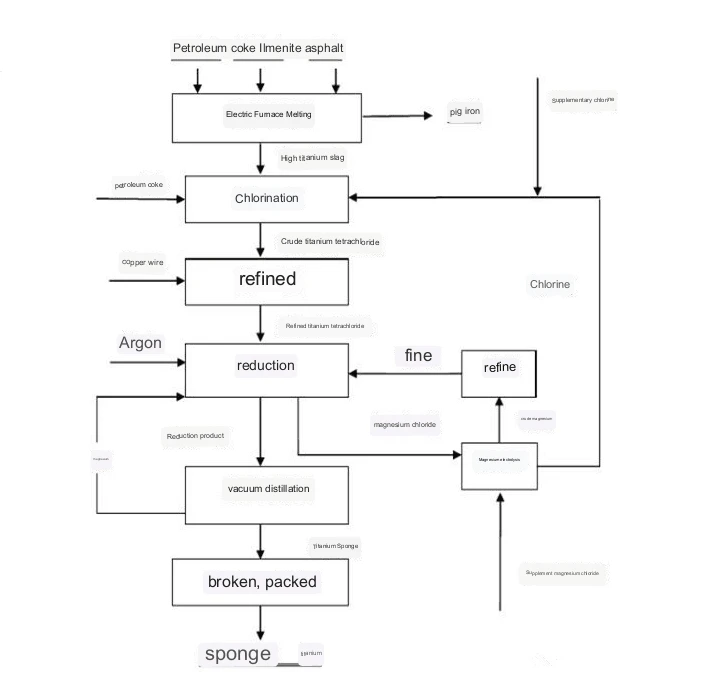
The by-product magnesium chloride produced in the reduction reaction using metallic magnesium as the reducing agent in the magnesium thermal method is electrolytically recovered to recover magnesium and chlorine. Magnesium continues to participate in the reduction reaction, and chlorine gas is transported to the greening workshop for recycling. After the distillation condensate is melted, the magnesium chloride is discharged, and the remaining magnesium can be used as a magnesium reducing agent to continue to participate in the magnesium thermal production process. Therefore, the recycling of metallic magnesium and chlorine is realized in the production of magnesium oxide. The recycling of magnesium chlorine gas reduces environmental pollution during the production of titanium sponge and reduces production energy consumption.


