


The difference between titanium screws and stainless steel screws
First of all, titanium screws are actually the same as screws made of ordinary materials. They just differ in size, size and texture. One is titanium and the other is stainless steel. Their strengths are different. Titanium screws and stainless steel screws are commonly used fasteners in the industrial field. They have the same function, but they are very different in terms of materials, performance and production processes. For example, titanium screws can resist fluorochloric acid, while stainless steel screws cannot meet this requirement. Let’s discuss the differences, advantages and disadvantages, and production process differences between titanium screws and stainless steel screws.
There are many types of titanium screws: pan head titanium screws, column head titanium screws, self-tapping titanium screws, titanium bolts, titanium nuts, internal hexagonal titanium screws, external hexagonal titanium screws, flange screws, non-standard titanium screws, etc. Different types have different uses.
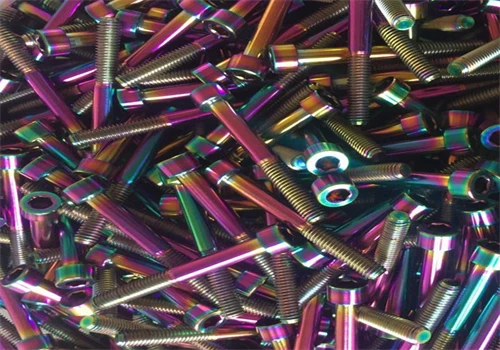
Titanium alloy screws and stainless steel screws are screws made of two different materials, and their strengths are also different. The material determines the strength of the screw, and its performance is also different.
Material: Titanium screws are made of titanium alloy, and titanium is a very light metal with high strength, corrosion resistance and high temperature stability.
In terms of performance:
Titanium screws have the advantages of light weight, high strength, and strong corrosion resistance, and are suitable for high-performance products such as high-speed ships and aircraft. , but generally speaking, the performance of titanium alloy screws is better than that of stainless steel screws. Therefore, titanium alloy screws are generally used in high-end equipment. However, which one of the two is lighter is also a question that many people are concerned about.
Appearance: The surface of titanium screws is silver-gray and is often used in decoration and handicrafts. Titanium bolts can also be produced in a variety of colors, while stainless steel screws are silver-white.
Which is heavier, titanium alloy screws or stainless steel screws? Titanium alloy screws are definitely lighter than stainless steel screws with the same dimensions. Titanium alloy screws are inherently characterized by low density and high strength. Their strength is much higher than stainless steel screws, so it is said that this product is generally used in aircraft, aerospace and electronic products, and some medical devices also use titanium alloy screws.

Advantages of titanium screws:
1. Light weight and high strength.
2. Good corrosion resistance.
3. Good stability under high temperature environment.
4. Excellent fatigue resistance.
5. Long service life.
Disadvantages of titanium screws:
1. The cost is higher.
2. It is difficult to process.
Disadvantages of stainless steel screws:
1. Heavy weight.
2. It may be less corrosive in high temperature environments.
3. Difficult to cut and process.


