


Titanium rod plastic processing
Plastic processing metallurgy is the study of the motion mechanism of metal crystal structures. It is the basic theory for controlling and improving thermodynamic and mechanical conditions in order to achieve the most effective plastic forming. It is developed by summarizing the results and practical experience of plastic forming industry over the years. Its main research task is to explore the thermodynamic and mechanical conditions suitable for deformation of metals and their alloys, and to seek process conditions that improve deformation performance, reduce deformation resistance, avoid defects, and achieve the best crystalline structure state and performance after deformation, in order to obtain Products with the best internal and external quality and meeting energy saving standards. Its main research contents include: titanium rods
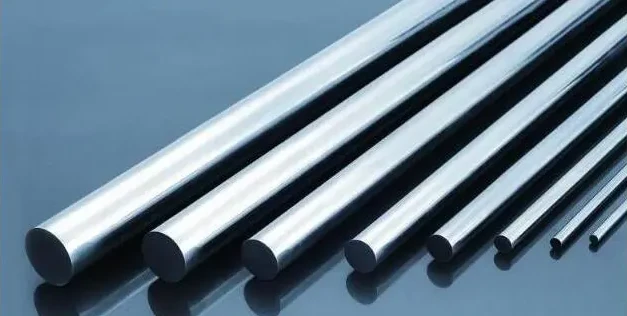
(1) Mechanism of metal plastic deformation. Metal plastic processing is to produce stable and continuous permanent deformation of metal subjected to external forces to give the material the desired shape and structure. It is extremely important to be familiar with the mechanism of deformation and its role in plastic deformation, its changing patterns and its consequences. On the basis of inheriting the knowledge of crystal structure in the material discipline, we will understand the relevant slip and dislocation theories and lay the foundation for a deep understanding of plastic deformation.
(2) Metal yield and deformation resistance. Metal can transform from elastic deformation to plastic deformation under a certain external force. This state is called yielding. The stress value when the metal yields represents the stress at which the metal has begun to flow, so the yield behavior of metal polycrystals needs to be studied. Polycrystals are composed of many single crystals with different orientations. Therefore, we must first study some yielding behaviors of single crystals and clarify their origins, so that we can correctly grasp the plastic deformation of metal polycrystals. Yielding only means that the metal has begun plastic deformation, while the S of plastic processing is to expect the metal to deform to a predetermined size to change the shape and size of the original blank, improve the mechanical properties, and obtain qualified products. The applied external force increases with the increase of deformation. To achieve the yield of metal and maintain stable continuous deformation, it is necessary to study the ability of metal to resist these intentions under various circumstances - the deformation resistance of metal.
(3) Thermodynamic conditions for metal plastic deformation. Metal must be subjected to external forces under certain mechanical and thermodynamic conditions in order to undergo the desired deformation. Thermodynamic conditions include the temperature, degree and rate of deformation, which restrict the success or failure of plastic deformation. Therefore, selecting and determining the deformation temperature range, deformation amount and deformation speed is the most basic knowledge for changing the essence of the internal structure of metal.
(4) Metal plastic deformation and changes in organizational properties. The purpose of metal plastic processing is to create optimal conditions to promote the expected shape changes and structural changes of the workpiece during the process of undergoing deformation, and to obtain the required good properties. Recently, in the process of developing new materials, materials produced by conventional adding methods are difficult to meet the requirements due to unsatisfactory structure or properties. The reason is the formation of deformation texture and recrystallization texture. In order to effectively control the formation and existence of texture and reduce adverse effects, research on the annealing and recrystallization process, structure and other special organization formation mechanisms and control technologies can be used to prepare materials containing special materials based on understanding their laws. Materials with performance requirements.
(5) Plasticity and fracture of metals. The metal can stably undergo plastic deformation without fracture, which is a sign that the metal has plasticity. Study the ability of metal to withstand plastic deformation without fracture under certain conditions, the conditions for promoting metal to reach its optimal state and ways to improve its plasticity. titanium wire
(6) Uneven deformation and residual stress. Any plastic deformation process is in a non-uniform state, so the occurrence and development of deformation and the resulting stress, strain and performance are all in a non-uniform state. Therefore, it is necessary to study the causes, adverse consequences and preventive measures of the occurrence and expansion of uneven deformation in order to achieve uniform deformation conditions as much as possible during the production process.


