


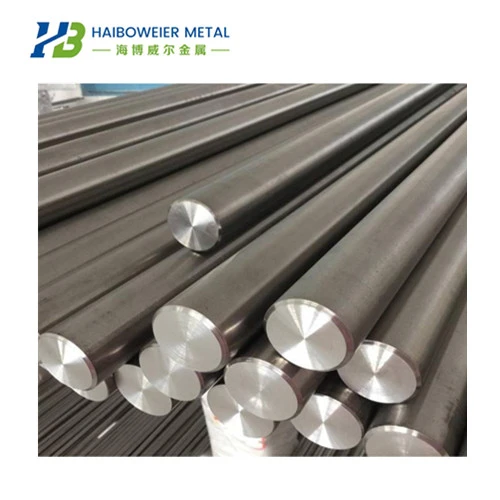
Titanium Rod For Chemical Industry
We use advanced production technology and state-of-the-art equipment to produce high quality chemical grade titanium rods that comply with industry standards Titanium rods for chemical industry can effectively withstand harsh chemical environments, meet the needs of the chemical industry , and are widely used in various chemical and chemical applications.
Product Introduction
The execution standard of our titanium rods for chemical industry is A STM B348, ASTM F136/F67, which meets the requirements of international titanium materials. The grades of materials to choose include grade 1, grade 2, GR5, GR7, GR-9, GR.12, etc. There are two production methods: forging machining and hot rolling machining. The specifications and dimensions are customized according to the actual application needs of the customer. Radiographic testing, coloring, flaw detection experiments and other testing can also be performed according to the customer's needs. Haibowell Titanium products include titanium plates, titanium tubes, titanium forgings, titanium ingots, rings, titanium foils, titanium fasteners, titanium round rods, square rods, hollow titanium rods, titanium wires, etc. If you have any questions you need to consult, you can ask our sales staff. We will give you a satisfactory answer as soon as possible. You are also welcome to come to the factory for actual inspection and look forward to happy cooperation with you!
Mechanical properties :

Mechanical properties :
|
Trademark |
Tensile strength, MPa ( min) |
Yield strength, MPa ( min) |
Elongation, % (minimum value) |
Area reduction rate, % ( min) |
|
Gr1 |
240 |
170 |
twenty four |
30 |
|
GR2 |
345 |
275 |
20 |
30 |
|
GR5 titanium alloy mechanical properties |
|
|
tensile strength |
σb/MPa≥895 |
|
Specify residual elongation stress |
σr0.2/MPa≥825 |
|
Elongation |
δ5(%)≥10 |
|
rate of reduction in area |
ψ(%)≥25 |
|
Ti-6Al-4V titanium alloy density: 4.5 (g/cm3) |
Ti-6Al-4V working temperature -100~550 (℃) |
Titanium and titanium alloy rods
|
Specification |
φ (6- 200) * L≤600 mm , minimum order quantity is 10kg |
|
Trademark |
Grl, Gr2, Gr3, Gr5, Gr7, Grl2 |
|
standard |
ASTM B348 AMS 4928 |
|
state |
Annealed state (M), hot working (R), cold working (Y) |
|
Remark |
Various titanium rods can be provided according to customer requirements. |
|
Product description: The production of titanium rods uses forging, extrusion, rolling and drawing processes, and the surface treatment includes black leather polishing. |
|
Materials used
The quality of the materials used in our titanium rod production is strictly screened. The main component of titanium is titanium, and its purity should be at least 99.5%. Impurities such as carbon, oxygen, nitrogen, and hydrogen should be limited within a certain range to ensure the overall strength and durability of the titanium rod. In addition to titanium, some other metals, such as iron, nickel and molybdenum, can also be added to improve certain properties of titanium rods.
of titanium rods for chemical applications involves multiple steps, including smelting and casting, hot rolling and cold drawing
1
The smelting and casting process is very important in determining the quality and purity of the titanium material.
2
During the hot rolling process, the titanium material is heated to a certain temperature and formed into a bar.
3
The cold drawing process helps increase the overall strength of the rod by stretching the titanium material to length.
4
These processes should meet specific standards to ensure the quality and stability of the final product.
In order to ensure the safety and reliability of titanium alloy rods, our company performs multiple testing procedures.
Visual inspection helps identify any surface defects such as cracks, inclusions and voids.
Chemical composition analysis is critical to determine the purity and concentration of the titanium material used in the rods.
Mechanical testing helps determine the tensile strength, yield strength, and elongation of the rod.
Ultrasonic testing is important for detecting internal defects such as pores and cracks.
Our titanium rods implement international standards:

Our titanium rods meet American standards:
1. ASME BPVC - This code contains rules for the design, construction, and inspection of boilers and pressure vessels, including those made of titanium. This code is critical to ensuring the safety of chemical processing equipment.
2. NACE MR0175 - This standard outlines requirements for materials used in oil and gas production in sour environments. It includes titanium materials used in chemical applications exposed to hydrogen sulfide (H2S).
3. ANSI/NACE MR0103 - This standard covers requirements for materials used in H2S-containing environments in oil and gas production. It includes titanium materials used in chemical applications exposed to H2S.
4. ASTM F1108 - This standard specifies the requirements for titanium alloy surgical implants. It includes chemical and mechanical properties, testing and surface conditions of these implants.
Titanium rod applications in chemical industry:
Chemical Reactors: Titanium alloys are often used in the manufacture of chemical reactors and pressure vessels due to their corrosion resistance and high temperature stability. These reactors can be used to process chemicals with strong acids, alkalis, high temperatures and pressures, such as sulfuric acid, methanol, hydrofluoric acid and sodium hydroxide.
Chemical storage equipment: Titanium alloys are often used to make containers, tanks and pipes for storing and transporting chemicals to ensure that the chemicals do not adversely affect the container materials.
Chemical valves and piping systems: The corrosion resistance of titanium alloys makes them ideal for handling corrosive chemicals such as strong acids and alkalis. It can be used to manufacture valves and piping systems to ensure safe piping and control chemicals
Chemical experimental equipment: In laboratories, titanium alloys are often used to manufacture experimental equipment, such as reactors, evaporators, separation equipment and storage containers. This helps ensure that experimental manipulations do not produce statistical data for chemicals.
Chemical equipment cooling system: Titanium alloy can also be used in the cooling system of chemical equipment to improve corrosion resistance and prevent damage to the equipment by the cooling medium.
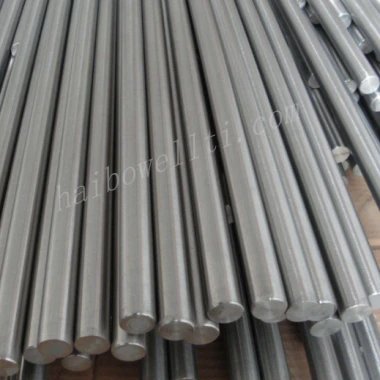


Hot Tags: titanium rod for chemical industry, China titanium rod for chemical industry manufacturers, suppliers, factory, Titanium Square Bar, Titanium Alloy Rod, Gr7 Titanium Bar, ASTMF67 Titanium Rod, Gr23 Titanium Bar, Titanium Bar For Medical
You Might Also Like


Send Inquiry
