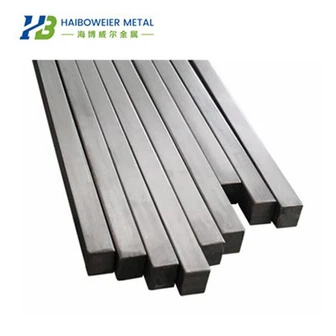
Commercial pure titanium series: Analysis on the differences in strength and application between TA3 and TA4
In the vast field of materials science, titanium alloys occupy a pivotal position in many industrial applications due to their unique physical and chemical properties. Commercial pure titanium, as an important branch of titanium alloys, is widely used in aerospace, medical equipment, chemical equipment and other fields due to its good corrosion resistance, light weight, high strength and good biocompatibility. Among them, TA1, TA2, TA3 and TA4 are the four main grades of commercial pure titanium. Although they are all α-phase alloys in terms of microstructure, there are significant differences in interstitial element content, mechanical properties and application fields. This article will focus on the differences in strength and application between the two grades of TA3 and TA4.

1. Interstitial elements: source of strength
The difference in strength of commercially pure titanium is mainly due to the difference in the content of its interstitial elements, especially the content of oxygen (O²) and iron (Fe). Interstitial elements refer to those atoms that can fill the gaps in the titanium crystal lattice, and they have a direct impact on the mechanical properties of titanium.
1) TA3 titanium: Compared with TA1 and TA2, the content of interstitial elements in TA3 has increased, especially the content of oxygen and iron. This increase significantly increases the ultimate tensile stress (UTS) of TA3, giving it higher strength. However, an increase in strength is often accompanied by a decrease in ductility, that is, a decrease in elongation.
2) TA4 titanium: As the highest strength grade among commercial pure titanium, TA4 has the highest content of interstitial elements, especially the content of oxygen and iron, which is much higher than other grades. This makes the ultimate tensile stress of TA4 more than twice that of TA1, making it the leader in the commercial pure titanium series. Despite the sacrifice in ductility, TA4's high strength makes it excellent in applications that require it to withstand extreme loads.
2. Differences in application fields
1) TA3 titanium: Due to its moderate strength and certain ductility, TA3 titanium has been widely used in the aerospace field. For example, it is often used to make structural parts for aircraft and rockets, as well as parts that need to withstand a certain amount of pressure but not be exposed to extremely harsh environments. In addition, TA3 is also used in the manufacture of medical devices, such as surgical instruments and implants, due to its good biocompatibility.
2) TA4 titanium: With its excellent high-strength properties, TA4 titanium plays an irreplaceable role in fields that need to withstand extremely high loads and extreme environments. For example, in the fields of deep-sea exploration and oil extraction, TA4 titanium is used to manufacture key components such as the shells and high-pressure pipelines of deep-sea submersibles. At the same time, due to its good corrosion resistance and high temperature stability, TA4 is also widely used in the construction of chemical equipment and nuclear power plants.
As two important grades of commercial pure titanium, TA3 and TA4 have significant differences in strength and application fields. TA3, with its moderate strength and good ductility, shows wide application prospects in aerospace and medical equipment fields; while TA4, with its excellent high-strength properties, can be used in extreme environments such as deep-sea exploration, oil exploration, and chemical equipment. plays an irreplaceable role. This difference is not only due to the difference in their interstitial element content, but also the product of the combination of material science and engineering technology, providing tailor-made solutions for different fields. With the advancement of science and technology and the expansion of applications, commercial pure titanium series will continue to shine on the stage of materials science.