


Detailed explanation of titanium tube straightening methods
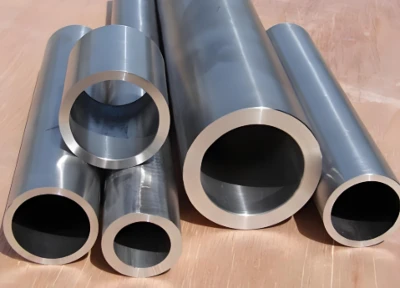
In industrial production, titanium tubes are widely used due to their excellent corrosion resistance, high strength and low density. However, titanium tubes may bend or deform during production or transportation, which will have an adverse effect on their subsequent use and performance. Therefore, it is particularly important to straighten titanium tubes. This article will introduce in detail the three main methods of titanium tube straightening: tension straightening, sinusoidal straightening and pressure straightening.
1. Tension straightening
Tension straightening, also known as tensile straightening, is a processing method that corrects shape defects by applying vertical tension to plastically extend the titanium tube. During the tension straightening process, the straightener applies tensile stress to the titanium tube that exceeds the yield limit of its material. This tensile stress is combined with the original residual stress of the titanium tube, so that part of the tensile stress is offset in the part with larger extension of the titanium tube, reducing the actual deformation stress, thereby reducing the plastic extension during straightening. In the part with smaller extension, due to the accumulation of tensile stress, the deformation stress actually increases, and the plastic widens during straightening. Therefore, under the action of tension, all parts of the titanium tube can be extended evenly, thereby eliminating the waveform defect.
Tension straightening has the advantages of good straightening effect and simple operation, and is particularly suitable for straightening slender workpieces such as titanium bars, titanium wires and titanium tubes.
2. Sinusoidal straightening
Sinusoidal straightening is a straightening method widely used for simple cross-section bars and pipes. In titanium tube straightening, sinusoidal straightening is usually carried out on an oblique roller straightener. The number of rollers of the oblique roller straightener is generally greater than 4, usually 5 to 29 rollers. Its working principle is to continuously bend three points of the workpiece through each roller, gradually reducing the range of variation of the residual curvature of the workpiece, thereby achieving the purpose of straightening.
Sinusoidal straightening is usually used together with pressure straightening. First, the titanium tube with a large curvature is initially straightened by a pressure straightener. Then, the titanium tube is sent to the oblique roller straightener for further straightening. The straightening effect mainly depends on the pressure of the straightener and the inclination of the rollers. The magnitude of the pressure depends on the yield strength and bending degree of the alloy material. For high-strength titanium alloys, when the curvature is large, a larger straightening pressure needs to be applied. The size of the roller inclination angle depends on the diameter of the workpiece. A larger straightening angle should be used for workpieces with a large diameter.
Sinusoidal straightening has the advantages of high straightening efficiency and wide application range. It is particularly suitable for straightening pipe-type workpieces such as titanium tubes and titanium rods.
3. Pressure straightening
Pressure straightening is a processing method that achieves the purpose of straightening by applying pressure to plastically deform the titanium tube. During the pressure straightening process, the appropriate straightening pressure needs to be determined based on the curvature of the titanium tube and the yield strength of the alloy material. For high-strength titanium alloys, when the curvature is large, a larger straightening pressure needs to be applied; conversely, for low-strength titanium alloys or titanium tubes with small curvature, a smaller straightening pressure can be applied.
Pressure straightening has the advantages of simple operation and low cost. However, since the titanium tube will undergo plastic deformation during the pressure straightening process, it may have a certain impact on the performance of the titanium tube. Therefore, when choosing a pressure straightening method, it is necessary to comprehensively consider factors such as the material, specification and curvature of the titanium tube.
Tension straightening, sinusoidal straightening and pressure straightening are the three main methods for straightening titanium tubes. In practical applications, it is necessary to select the appropriate straightening method based on factors such as the material, specification and bending degree of the titanium tube. At the same time, it is also necessary to pay attention to controlling the straightening parameters and process conditions during the straightening process to ensure high-quality straightening results. Through reasonable straightening treatment, the performance and service life of titanium tubes can be significantly improved, providing strong guarantees for industrial production.


