


How to Choose Between Forged and Rolled Titanium Bars
An Analysis of the Differences Between Forged and Rolled Titanium Bars. A deep dive into their mechanical properties, industrial applications, and how to select the appropriate titanium material for sectors such as aerospace, automotive manufacturing, and the chemical industry.
Are Forged Titanium Bars and Rolled Titanium Bars the Same Thing?
When selecting materials, it is a common misconception that forged titanium bars and rolled titanium bars are interchangeable. However, these two types possess fundamental differences in terms of their manufacturing processes, internal structures, and mechanical properties.
If the material is intended solely for decorative purposes, selecting the wrong type may be of little consequence; however, for applications involving dynamic heavy loads, high temperatures, high pressures, or critical safety components, selecting the wrong material will directly compromise the equipment's reliability and operational safety.
Differences in Manufacturing Processes
- Rolled Titanium Bars (Hot Rolling / Cold Rolling Processes)
This process involves heating raw materials and passing them through a rolling mill, where they are repeatedly compressed and shaped into a bar profile.
Key Characteristics:
High production efficiency
Lower manufacturing costs
Relatively uniform appearance
Moderate internal density
However, their internal structure tends to be relatively loose and lacks robustness; furthermore, their toughness is poor, and their mechanical performance is limited. Consequently, they are suitable only for use in decorative accessories and are completely unsuitable for any load-bearing applications.
Learn More AboutOur Titanium Round Bar Specifications:https://www.haibowellti.com/titanium-rod/titanium-alloy-rod/
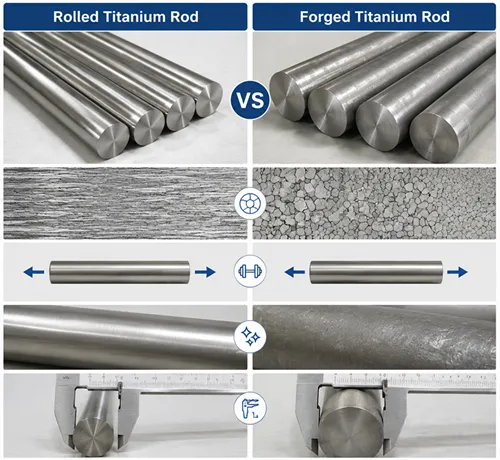
2.Forged Titanium Bars (Hot Forging Process)
These bars are produced by subjecting the material to high-temperature heating followed by repeated hammering and compaction using a press. The overall texture is extremely robust; specifically, their hardness, toughness, and tensile strength are vastly superior to those of standard rolled titanium bars.
This process significantly enhances the following properties:
Grain refinement (resulting in a finer microstructure)
Internal density and uniformity
Fatigue resistance
Tensile strength
In short:
The forging process reshapes the material's structure at a microscopic level, rendering it stronger and more reliable.
Mechanical Property Comparison
Rolled Titanium Bar
Suitable for non-critical or low-stress applications:
Protective Shields, Static Supports, Non-load-bearing Structures
Advantages:
High Cost-Effectiveness, Easy to Process, Suitable for Stable Environments
Limitations:
Lower Fatigue Resistance
Unsuitable for High-Frequency Vibration or Heavy-Load Conditions
Forged Titanium Rods
Typical Applications:
Aerospace Engine Shafts
Chemical Agitator Shafts
Automotive Suspension Components
High-Pressure Industrial Systems
Advantages:
High Tensile Strength
Excellent Fatigue Resistance
Superior Structural Stability
Long Service Life Under Extreme Conditions
Conclusion
Rolled titanium bars are designed specifically for applications prioritizing cost-effectiveness and low internal stress, whereas forged titanium bars are engineered for high-performance and safety-critical environments. From an engineering perspective:
Rolled Parts = "Serviceable"
Forged Parts = "Reliable Under Extreme Conditions"
Call to Action (CTA)
Are you looking for high-performance titanium materials for your application?
We offer:
Forged Titanium Bars (Grades 1 / 2 / 5 / Titanium Alloys)
Rolled Titanium Bars
Aerospace and Medical-Grade Titanium Solutions
Custom Sizing and Precision Machining Services
👉 Contact us today for technical consultation and a quote:
Get a Quote
Email: haibowelljs@163.com
WhatsApp/WeChat:8613636823845


