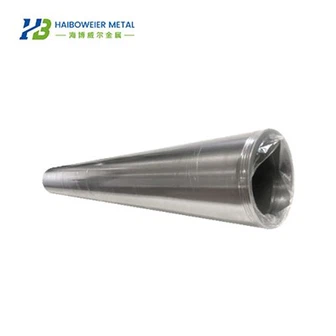
Selection of titanium materials
Because titanium (titanium and titanium alloys) has good mechanical and physical properties, it has low density and high strength. The ratio of tensile strength σb to density ρ σb/p=200 is almost the highest among all metal materials. . At the same time, it has very excellent corrosion resistance. Titanium's excellent chemical stability in highly corrosive environments and its strong self-passivation ability in electrolytes (containing water) have made the application and promotion of titanium materials faster than many other metals.
Generally speaking, industrial pure titanium has better corrosion resistance than α-phase titanium alloys and β-phase or α+β-phase titanium alloys, and has a wider range of applications. Although its strength is not as high as β-phase titanium alloys or α+β-phase titanium alloys , but has good plasticity and is easy to process and form. Therefore, industrial pure titanium is the most commonly used material in titanium containers.
1) Deformed titanium materials should be supplied in the annealed state (M), and titanium castings should be supplied in the cast state.
2) TA3 among the deformed industrial pure titanium TAO, TA1, TA2, and TA3, due to its poor cold deformation ability, is generally not suitable for use in components such as cylinders, heads, and bubble caps, and can only be used without cold deformation or cold deformation. Smaller parts.

3) TA9 titanium-palladium alloy (Ti -0. 2Pa) and TA10 titanium-nickel-molybdenum alloy (Ti -0.8Ni -0.3Mo) are mainly used in high-temperature, moist chlorine-containing media and possible crevice corrosion (especially TA9 is more resistant to crevice corrosion) It is particularly suitable for use as tube sheets, flanges and other components.
4) If there is a galvanic couple, the following measures can usually be taken:
①Combine a metal (usually a metal subject to galvanic corrosion) with an insulating material;
② Add a completely isolated insulating material between the two metals to avoid the formation of a corrosive battery;
③ Increase the distance between different metals, or change the position between them to avoid cathode contamination;
④ Avoid the formation of a large cathode and a small anode between the two metals in the battery;
⑤ Use cathodic protection.
5) If there is crevice corrosion, the following measures can usually be taken:
① Adopt reasonable structural design, try to avoid or eliminate gap stagnation areas and fouling phenomena, improve the flow state of fluid in the equipment, and avoid the formation of dead zones. When internal bolt connections are made, welding connections should be used as much as possible, and spot welding overlaps should be continuous as much as possible. Lap welding or butt welding.
② Use palladium coating, oxidation or anodizing on the surface where crevice corrosion may occur.
③ Filling the gaps with putty mixed with NiO or nickel powder or MoO3 powder can sometimes avoid crevice corrosion.
④Choose titanium materials that are more resistant to crevice corrosion, such as titanium-palladium alloy (TA9) or titanium-nickel-molybdenum alloy (TA10). These titanium materials are especially suitable for flanges with crevice corrosion on the flange sealing surface.
6) If hydrogen embrittlement occurs, the following measures can usually be taken:
①Choose titanium materials with low hydrogen content.
② Prevent hydrogen absorption during the manufacturing process, that is, avoid embedding iron particles on the titanium surface during cutting, stamping, coiling, welding and other manufacturing processes; heat processing and heat treatment heating must be carried out in a heating furnace with a micro-oxidizing atmosphere; For some titanium equipment with complex structures, it is difficult to achieve inert gas-protected welding joints on the back side to prevent contamination and hydrogen absorption during welding.
③Choose a suitable usage environment: When used in dry hydrogen and wet hydrogen environments with a temperature of 71~316°C, hydrogen absorption can be prevented if it contains a certain amount of oxygen and moisture. When titanium is in an oxidizing medium, a neutral medium, a weak reducing medium or a reducing acid containing an oxidizing agent, titanium usually does not absorb hydrogen, or absorbs hydrogen very slowly; but when the titanium surface is contaminated by iron, has surface defects, When local corrosion occurs or abnormal working conditions occur, hydrogen absorption embrittlement of titanium may occur. Titanium is prone to hydrogen embrittlement in environments where general corrosion or local corrosion occurs.

④The hydrogen absorption resistance can be improved through surface treatment, such as high-temperature oxidation, anodization, etc.
⑤ Use corrosion-resistant alloy to improve the corrosion resistance of titanium and prevent titanium from absorbing hydrogen and embrittlement.
7) Titanium materials are strictly prohibited to be used in liquid chlorine and dry chlorine gas situations.
8) Titanium materials are strictly prohibited from being used in fuming nitric acid with a moisture content less than 2% or free nitrogen dioxide greater than 6%.
9) Titanium materials should be avoided from being used in stress corrosion environments. Any medium with a tendency to stress corrosion cannot be used, even if it is slightly corrosive to titanium, but there is still a risk of stress corrosion cracking.