The Development Prospects Of Titanium Alloys in Deep-Sea Engineering
Deep-sea engineering, as a crucial component of marine development, is continuously extending into higher pressure and more complex environments, placing extremely stringent demands on material performance. Traditional metallic materials are prone to performance degradation under long-term high pressure and high corrosion environments, while titanium alloys, with their superior comprehensive properties, are gradually demonstrating irreplaceable value in the field of deep-sea engineering, and their development potential continues to attract attention.
Higher Requirements for Materials in the Deep-Sea Environment
Deep-sea areas are characterized by high pressure, low temperature, and strong corrosion. Equipment operating in such an environment for extended periods requires materials with extremely high stability and reliability. Ordinary metals are prone to corrosion, fatigue, and even structural failure under these conditions, while titanium alloys can maintain stable performance in extreme environments. They not only exhibit outstanding corrosion resistance but can also withstand enormous pressure, making them an important direction in the selection of materials for deep-sea engineering.
Performance Advantages of Titanium Alloys
Titanium alloys combine high strength with low density, effectively reducing overall weight while maintaining structural strength. This is crucial for the transportation and installation of deep-sea equipment. Furthermore, their surface forms a stable oxide film, effectively resisting seawater corrosion and maintaining good condition even during long-term use. In addition, their superior fatigue resistance allows them to maintain structural integrity under complex loads, providing reliable protection for deep-sea engineering.
Expanding Typical Application Scenarios
With continuous technological advancements, the application scope of titanium alloys in deep-sea engineering continues to expand, with their advantages manifested in several key areas:
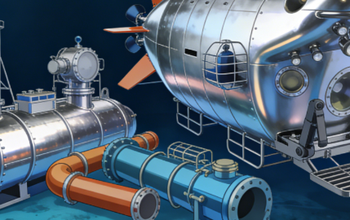
- Pressure hulls for deep-sea submersibles, improving safety and stability
- Structural components for seabed observation equipment, enhancing long-term service capability
- Deep-sea pipeline systems, reducing corrosion risk
- Key components for seabed energy development devices, extending service life
- Underwater robot shells, improving environmental adaptability
These applications not only demonstrate the performance advantages of titanium alloys but also reflect their important role in deep-sea engineering.
Limiting Factors and Technological Breakthrough Directions
Although titanium alloys boast outstanding performance, their high production cost, complex processing, and stringent equipment and process requirements have limited their widespread adoption. However, with continuous advancements in smelting, precision machining, and welding technologies, these issues are gradually being mitigated. Future large-scale production and technological optimization are expected to further reduce costs, enabling their application in more deep-sea engineering projects.
Enhancing the Safety and Reliability of Deep-Sea Engineering
Deep-sea engineering is inherently high-risk. Equipment malfunctions result in extremely difficult repairs, thus demanding exceptionally high material reliability. Titanium alloys maintain stable performance during long-term service, reducing failures caused by corrosion or fatigue, thereby significantly improving overall engineering safety. This stability is crucial for ensuring the smooth operation of deep-sea activities, making it a key structural material choice.
Promoting the Development of Deep-Sea Technology
The application of titanium alloys is driving deep-sea engineering to a higher level. Their superior performance provides a foundation for exploration in deeper waters, enabling scientific research equipment and engineering equipment to operate stably in more extreme environments. It also promotes the integration of materials science and marine engineering technology, bringing more possibilities for future deep-sea resource development and scientific research.
Future Application Directions and Development Trends
In future development, titanium alloys will demonstrate broader application potential in the field of deep-sea engineering:
- Combining with new composite materials to enhance overall performance
- Applying to equipment in deeper waters to expand engineering boundaries
- Promoting lightweight structural design to improve energy efficiency
- Playing a key role in intelligent deep-sea equipment
- Achieving cost control and large-scale application through process optimization
With continuous technological progress and sustained growth in demand, the status of titanium alloys in deep-sea engineering will be further enhanced, and they will play an important role in more key areas.