


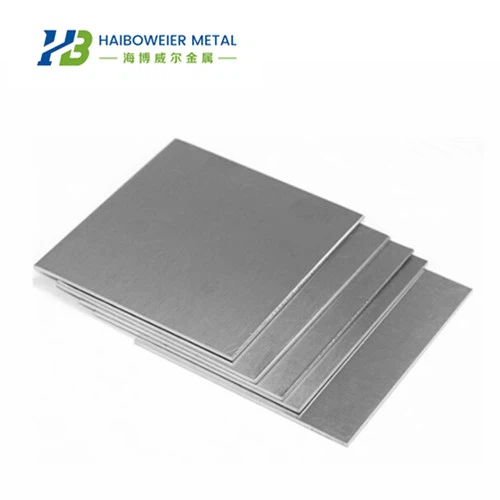
Titanium Nickel Memory Alloy Plate
Name: Titanium Nickel Memory Alloy Plate
Standard: ASTM F2063-2018
Brand: Niti, NitiCr, NitiCu, NitiNb, NitiFe, etc.
Shape memory alloy: good elasticity and high strength
Sheet alloy : thickness ≥0.05mm
Main ingredients : titanium (Ti) and nickel (Ni)
Minimum yield strength : 1200 MPa
Hardness : 250HB
Processing methods: including hot rolling, cold rolling and heat treatment
Product Introduction
Our titanium-nickel memory alloy sheets are produced in accordance with ASTM F 2063 , the implementation standard for medical devices and surgical implants . The material is capable of reversible phase change between two different crystal structures, allowing it to change when heated to a specific temperature. its shape and restore its original shape. While unidirectional shape memory alloys are suitable for use in sensors, bidirectional shape memory alloy plates are ideal for actuators that can change shape in both directions .
Common types of alloys include nitinol (nickel titanium), copper-aluminum-nickel alloys, and iron-platinum alloys, among others. The specification covers the chemical, physical, mechanical and metallurgical requirements for wrought nickel-titanium rods, flat-rolled products and tubes containing 54.5% to 57.0% nickel for use in the production of medical devices and surgical implants. These requirements apply to rolled products from 6 to 130 mm (0.24 to 5.12 inches) in diameter or thickness in the annealed condition.
Titanium-nickel alloy is an equiatomic intermetallic compound (Ti50Ni50). The practical alloy composition is Ti-(49-51)%Ni (atomic fraction). Titanium-nickel intermetallic compounds are ductile and can be hot and cold worked. The cold working rate is 10% to 25%, and the recrystallization temperature is 500 to 600°C. Titanium-nickel alloy has excellent corrosion resistance in the high-temperature phase, good damping in the low-temperature phase, and unique memory properties and superelasticity in the phase change zone. The properties of titanium-nickel alloy are as follows:
nickel-titanium shape memory alloy sheets :
|
Density (g·cm -3) |
6.45 |
|
Melting point/℃ |
1240∽1310 |
|
Specific heat/kJ · (kg ·K )-1 |
0.46 |
|
Thermal Conductivity (Room temperature) W · (m · K)-1 |
10 |
|
Resistivity/10 -6Ώ·m |
80 |
|
Expansion coefficient/10 -6 · K -1 |
10.4 |
|
Elastic modulus/GPa |
40∽80 |
|
Hardness (HV)) |
180∽200 (low temperature stage) |
|
200-350 (high temperature stage) |
|
|
Tensile strength/MPa |
700-1100 |
|
Yield strength/MPa |
50-200 |
|
100-600 |
|
|
elongation/% |
20-60 |
Characteristics of Nitinol sheets :
|
Phase change Af/℃ |
-10∽100 |
|
Recoverable strain/% |
8 (maximum strain) |
|
6 (low number of repetitions) |
|
|
2 (number of repetitions, N=10 5) |
|
|
<0.5 (memory fatigue life, N=10 7) |
|
|
end use (Ultimate use) Temperature/°C |
AF +60 250 |
|
Maximum recovery stress/MPa |
680 |
The processing method of titanium-nickel alloy plates involves multiple stages :
First, the raw materials are heated to high temperatures and alloyed into a homogeneous mixture .
The mixture is then melted and cast into the desired shape and size, depending on the application requirements.
The plates are precisely processed through high-pressure forging and heat treatment processes to meet specifications and achieve uniformity.
Advantages of titanium-nickel memory alloy plates :

Application areas:
Medical devices: Nitinol alloys are widely used in the manufacture of stents, guide wires, clamps and other medical devices, especially in cardiac and vascular interventional surgeries. Their superelasticity and shape memory effects allow these devices to be easily introduced into the body and expand or assume multiple shapes under specific conditions.
Aerospace: Nickel-titanium alloy is used in the aerospace field to manufacture elastic components, servos, valves, etc. Its super elasticity and high responsiveness enable it to play an important role in some special environments.
Automotive Industry: Used in the manufacture of valve springs, brake systems, shock absorbers and other automotive parts to improve performance and braking.
Electronic equipment: Nickel-titanium alloy handles are used to manufacture components in micro-electronic equipment such as micro-motors and electric drives.
Our titanium product pictures


Hot Tags: Titanium Nickel Memory Alloy Plate, China Titanium Nickel Memory Alloy Plate manufacturers, suppliers, factory
You Might Also Like


Send Inquiry
