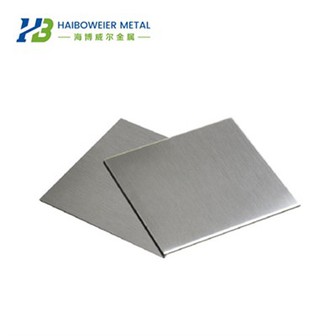
What processes can be performed on the titanium outer layer?
The outer layer of titanium metal can be processed: electroplating, sandblasting, pickling, micro-curve oxidation, anodizing, cleaning, and crystallization
1. Electroplating
Electroplating is the process of applying a metal or alloy coating to the outer layer of titanium using electrolytic standards. Usually to improve the wear resistance and visual beauty of titanium metal. In the electroplating system, titanium metal serves as the cathode filling and the covering material serves as the anode filling. Particles in the electrolyte move charges to complete the proofing of the coating. This electroplating process has the advantages of short processing cycle, low cost, uniform coverage thickness, and is suitable for titanium metal products of different shapes and sizes.

2. Sandblasting
Sandblasting is a process that utilizes the interaction of high-velocity wind streams to blast sand particles onto the outer layer of titanium metal to eliminate surface dirt, oxides, and surface marks on the product. Sandblasting can not only improve the roughness of the titanium surface, but also improve the coating's adhesion. This sandblasting process has the advantages of strong activity, high efficiency, and simple operation, and is suitable for surface treatment of large titanium metal products.

3. Pickling
Pickling is a process that uses corrosives to chemically react with oxides and pollutants in the outer layer of titanium metal to remove surface dirt and clean surface impurities. During the pickling process, the corrosive chemical reacts with the titanium surface to create soluble salts, which are then washed away by chemicals that clean the stain and clear the dirt. This process has the advantages of simple operation, high efficiency, low cost, and is suitable for titanium metal products of different shapes and sizes.
4. Micro-arc oxidation
Micro-segment oxidation is a process that uses micro-bending releases to create a ceramic covering on an outer layer of titanium metal. During the arc oxidation process, micro-bends are released to form a high-temperature and high-pressure climate in the outer layer of titanium metal, prompting the outer layer of titanium metal to form a thick ceramic covering layer, which has strong wear resistance, corrosion resistance and protective properties. The micro-arc oxidation process is suitable for titanium metal results of different shapes and sizes, and is particularly reasonable for corrosion-safe applications in marine conditions.
5. Anodizing
Anodizing is an interaction that uses electrolytic standards to form an anodized film on the outer layer of titanium metal. In the anodizing system, titanium metal serves as the anode and moves charges through the particles in the electrolyte, thereby forming a thick anodized film on the outer layer of the titanium metal. This anodizing process has the advantages of wear resistance, anti-consumption, protective performance and product aesthetics, and is suitable for titanium metal products of different shapes and sizes.
6. Polishing
Cleaning is a cycle that utilizes abrasives and cleaning experts to crush and clean the outer layer of titanium. During the cleaning process of the system, abrasives and cleaning experts work together to make the outer layer of titanium metal as smooth as a mirror. This cleaning system has the advantages of high processing quality, high surface finish, and is suitable for titanium metal results of different shapes and sizes.
7. Crystallization
Crystallization is a process that uses heat and cooling to form a glass-like covering on the outer layer of titanium metal. During the crystallization interaction, rising temperatures cause the outer layer of titanium metal to relax and form a translucent covering due to surface pressure during cooling. The crystallization process has the advantages of hindering wear and resisting consumption, and the results are reasonable for titanium metal of different shapes and sizes.
So, those are the seven processes that should be possible on titanium surfaces. Each treatment process has its own properties and range of applications. When selecting reasonable interactions, they should be selected and simplified based on clear usage requirements and processing conditions.